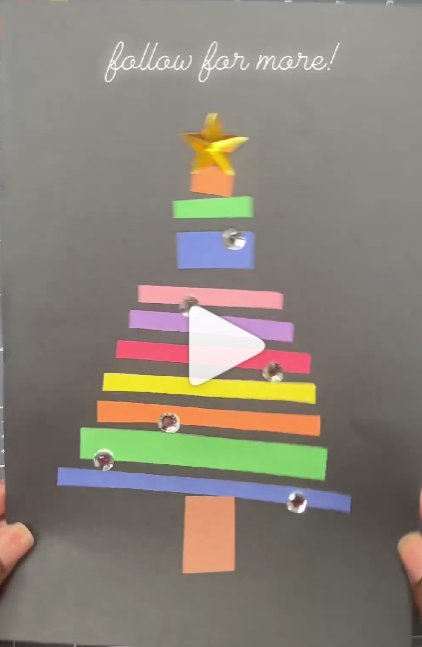
 Early childhood education lays the groundwork for a child's cognitive development, and fostering math and problem-solving skills is crucial during these formative years. The holiday season offers a natural, playful context to practice sequencing, measurement and patterning with young children. This article demonstrates a simple paper-strip Christmas-tree activity and connects it to professional learning you can take on ChildCareEd — start with Math Foundations in Early Childhood
  Buy Now $16.00 or No Such Thing as Boring Math Buy Now $24.00 to deepen your curriculum design and instructional scaffolding. You will find step-by-step facilitation advice, classroom extensions, and links to ChildCareEd articles and courses that help you translate a single craft into ongoing math instruction. #math #preschool #STEM #development #play
Why are early math and problem-solving skills important?
Before delving into the Christmas tree craft activity, let's understand why it's essential to focus on math and problem-solving skills in #early-childhood. Research has shown that early exposure to mathematical concepts contributes significantly to a child's overall academic success. Moreover, problem-solving skills are fundamental for navigating various challenges in life, laying the foundation for critical thinking and logical reasoning.
How can educators make early math learning fun?
The key to successful #early-childhood-education is making learning enjoyable. Engaging activities not only capture the attention of young learners but also enhance their understanding and retention of concepts. This Christmas tree craft provides an exciting and festive avenue for children to explore math and problem-solving in a hands-on and entertaining way.
How do I prepare the materials and environment for this craft?
To embark on this educational adventure, gather the following materials:
- Colored construction paper
- Scissors
- Glue
- Craft gems for decoration (optional)
Now, let's guide your preschoolers through the step-by-step process of creating their very own Christmas tree:
How should I introduce the activity to children?
Before diving into the crafting process, talk to the children about Christmas trees and their various decorations. Show them pictures or small Christmas tree decorations to build excitement and provide context for the activity.
What skills does cutting strips develop and how should you scaffold it?
Distribute colored construction paper to each child and encourage them to choose favorite colors. Guide them in cutting strips of paper in varying lengths; model safe scissor holds, and offer pre-drawn lines for children who need additional support. This step builds fine motor control, bilateral coordination and emergent measurement language (longer/shorter, compare, estimate). For holiday-specific ideas that target small-muscle control and scissor practice, see How to boost fine motor skills: Holiday Edition. Consider pairing the activity with the Letter & Number Planning in Child Care Buy Now $24.00 course to intentionally connect cutting practice with emergent literacy and numeracy objectives.
How does sorting by length teach mathematical concepts?
Once the strips are cut, prompt the children to organize them based on length. Discuss the concepts of short and long, encouraging them to compare the strips and arrange them accordingly. This sorting process lays the groundwork for more advanced mathematical concepts in the future.
How do you assemble the tree to teach sequencing and measurement?
Now comes the fun part – assembling the Christmas tree! Instruct the children to glue the strips vertically on a separate sheet of construction paper, arranging them from longest to shortest. This activity reinforces the understanding of order and sequence while providing a visual representation of size differences.
How can decorations teach spatial reasoning and choice-making?
For an extra touch of creativity, offer craft gems as decorations. This step not only adds a festive flair but also introduces the concept of spatial reasoning as the children decide where to place each gem on their Christmas tree.
How can I extend the activity to deepen math and problem-solving learning?
Extend the learning beyond the craft activity by incorporating additional math and problem-solving challenges. For example:
- Counting: Count the number of strips used to build the tree. This reinforces basic counting skills.
- Patterning: Encourage children to create patterns with the colored strips, introducing the concept of repetition and sequences.
- Grouping: Have the children group the strips into sets based on colors or lengths, promoting classification skills.
What are the key takeaways for practitioners?
Incorporating math and problem-solving into everyday play — even a short holiday craft — supports sequencing, measurement, patterning and spatial reasoning while keeping children engaged. Use intentional prompts (e.g., "Which strip is longer?"), scaffolded questions, and quick observational notes to document learning and differentiate instruction. Pair this activity with other classroom practices described in Creativity & Logic Activities and the curriculum-planning guidance in Tiny Tots, Big Learning to build unit plans and assessment moments. Finally, enroll in targeted ChildCareEd courses listed above to translate single lessons into sequenceable learning goals and measurable outcomes. #math #preschool #instruction #play #STEM
Which ChildCareEd courses can help me plan intentional early math learning?
ChildCareEd offers short courses and longer credentials that help you turn holiday crafts into standards-aligned lessons. Useful offerings include Math Foundations in Early Childhood Buy Now $16.00 (hands-on classroom strategies), No Such Thing as Boring Math Buy Now $24.00 (developmental frameworks for math in play), and Letter & Number Planning in Child Care Buy Now $24.00 (planning activities that integrate literacy and numeracy). Use these courses for PD or curriculum planning; always confirm acceptance with your state registry or employer before claiming formal credit.
To extend the idea across your program, see related ChildCareEd articles on daily math practices and STEAM: How to support early math skills every day, How preschool teachers can support early math, and STEAM Learning in the Early Childhood Education Classroom.
Watch ChildCareEd's video on Instagram and follow for more inspiration!
How can practitioners summarize and apply these strategies program-wide?
Translate the single-session craft into program-level learning by stating measurable objectives, planning differentiation, and creating quick assessment moments. Begin by writing one or two observable objectives (for example, "Child will order five strips from longest to shortest with 80% accuracy") and record a short baseline observation during the activity. Use the craft to tier instruction: offer pre-drawn cutting lines or adapted scissors for learners needing fine-motor support, provide challenge prompts (e.g., create a repeating color pattern, estimate and then measure strip lengths) for learners ready for extensions, and create a partner task that emphasizes communication and justification of choices. Implement rapid documentation: a one-sentence anecdotal note, a photograph of the assembled tree, and a short child quote capture key evidence you can use in planning conferences or family communication. Share a simple family extension (send home a template and a two-step prompt) to encourage generalization. Finally, map the activity to your program's learning goals and use the ChildCareEd courses and internal curriculum resources already linked in this article as PD supports—confirm any formal credit or registry acceptance with your state agency or employer. These steps help turn a festive craft into sequenceable, assessable learning across your classroom and program.
- Mysteries of Challenging Behavior Solved
- CDA Home Visitor Subject Area 2 Part 3 Birth to 5
- CDA Infants/Toddlers: Health and Safety
- 24 Hour Texas Pre-Service
- Math Foundations in Early Childhood
- Early Childhood Education
- 45-Hour Infant and Toddler Curriculum
- Texas Director Credential
- CDA Infants/Toddlers: Stages of Development
- Enhancing STEM Education for Infants and Toddlers
- Creativity & Logic Activities
- Building Social Foundations
- Counting Candy Canes: The STEM of Holiday Fun for Early Learners
- CDA Certification en Español: Recursos y Consejos para Educadores Bilingües
- A Path to Engaged Learning: Play!
- Actividades de Otoño Fáciles para Preescolares esta Temporada
- How can child care programs support cognitive development through problem-solving activities?
- How Does Play Support Children’s Physical, Cognitive, and Social Growth?
- What Does Toy Story 5 Teach Us About the Power of Imaginative Play?
- How can I use simple STEM activities to spark curiosity in preschoolers?
- Can Block Play Build Children's Spatial Skills?
- How Can Child Care Programs Build Meaningful School Readiness?
- How Can Child Care Providers Create Effective Learning Centers in Small Spaces?
- How Can Providers Show Families the Learning Behind Play?
- How Can You Make Addition Practice More Engaging Without Losing the Learning Goal?
- How Can Child Care Providers Make Counting and Simple Operations Playful?
- How Can Child Care Providers Build One-to-One Correspondence with Small Objects?
- How Do Dot-to-Dot Activities Support Number Order and Pencil Control?
- How Can a Fourth of July Activity Pack Blend Literacy and Math?
- How Can Patterned Practice Help Young Children Master Subtraction Facts?
