When a child hangs back during group time or joins in quietly, families may wonder what participation looks like and how it is developing. The Recognize, Respond, Respect: Supporting Diverse Learners  Buy Now $55.00 course can help you observe participation inclusively, interpret different ways of engaging, and plan responsive next steps. Pair those practices with clear, specific updates so families can see the learning behind each small step.
Why does classroom participation deserve careful documentation?
Participation is more than speaking during circle time or volunteering an answer. A child may contribute by watching closely, pointing to a picture, using a communication device, moving to music, offering a toy to a peer, or returning to an activity after a break. If educators recognize only the most visible or verbal responses, they can miss genuine learning and unintentionally communicate a narrow idea of what engagement means.
Thoughtful documentation helps families understand how children approach classroom experiences and how their skills are changing over time. It also helps educators consider whether a routine, material, group size, or communication strategy is supporting access. NAEYC recommends ongoing, purposeful assessment that is developmentally, culturally, and linguistically responsive; observations should inform teaching as well as communication with families. See its guidance on observing, documenting, and assessing children’s development and learning.
This matters especially when children participate differently across contexts. A child who rarely speaks in a large group may share ideas freely while building with two friends. Describing context gives families a more accurate, strengths-based picture than a general label such as “shy” or “not engaged.”
What does meaningful participation look like?
Begin with an open definition that includes different modes, levels, and moments of engagement. Participation may be independent or supported, verbal or nonverbal, brief or sustained. It can also change depending on the activity, sensory demands, relationships, language, fatigue, and a child’s familiarity with the setting. The purpose is not to make every child participate identically; it is to notice whether each child has meaningful opportunities to connect and contribute.
Look for observable actions rather than judging a child’s motivation. Examples might include orienting toward a story, choosing a material, imitating a peer’s action, taking a turn, communicating a preference, or asking for help. Record the situation as well as the action: “During the three-child puzzle activity, Lina handed a piece to a peer and stayed until the group finished,” is more informative than “Lina participated well.”
- Notice engagement during play, routines, transitions, outdoor time, and planned group experiences.
- Count gestures, facial expressions, movement, home-language contributions, and use of assistive communication as meaningful responses.
- Consider what supports were available and whether the child had a genuine choice to join, observe, or take a break.
- 😊 Celebrate small steps, such as approaching a group, watching a peer, or rejoining after time away.
Observation should reflect the whole child, not a single moment or setting. NAEYC’s guidance on using observation to guide teaching emphasizes watching and listening intentionally, then using what is learned to adjust strategies and plan experiences.
How can teachers collect useful evidence without turning the day into testing?
Keep documentation manageable and connected to everyday practice. Decide on a participation focus—such as taking turns, expressing preferences, or joining a peer activity—and observe a few children at a time across different settings. A brief note made soon after an interaction can preserve details without interrupting play. Add the date, context, what the child did or said, any support offered, and what happened next.
Use multiple forms of evidence where appropriate: anecdotal notes, children’s words, work samples, family insights, or photographs when permission and program policy allow. Avoid collecting images simply for display; documentation should have a clear purpose and protect privacy. Review notes periodically to look for patterns. Does the child participate more readily in a small group? Does a visual cue help? Is there a specific peer, material, or routine that makes joining easier?
Make observations useful by linking them to planning. If a child watches peers build but does not yet enter the play, you might add duplicate materials, invite a familiar partner, or model a simple way to offer a block. Then observe whether the adjustment changes access or interaction. NAEYC notes that educators can use informal and formal evidence to inform curriculum, communicate with families, and evaluate their own practices. The goal is not to accumulate paperwork; it is to notice, reflect, and respond.
How can you explain progress to families clearly and respectfully?
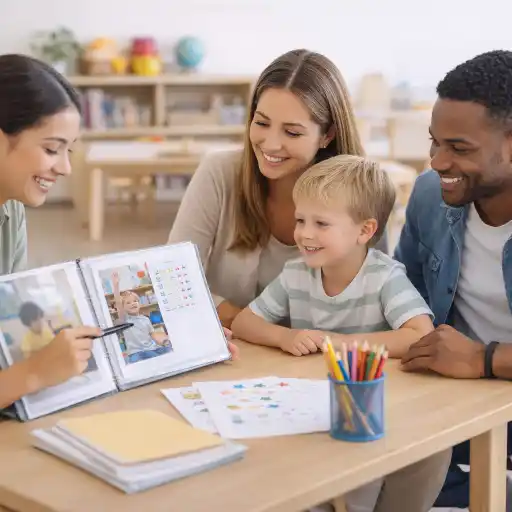
Share specific examples in plain language, then invite the family’s perspective. A brief update can describe what the child did, the context, and why it matters: “At story time, Mateo pointed to the picture of the bus when the group named vehicles. He watched through the whole story and chose the bus book afterward.” This tells a richer story than “He had a good day” and avoids treating speaking aloud as the only evidence of learning.
- Lead with a strength or emerging skill before discussing a concern.
- Describe behavior and context; avoid labels, comparisons, and unexplained professional jargon.
- Offer information in the family’s preferred language and communication format when possible.
- Ask families what they notice, value, or hope to support next.
For a concise end-of-lesson recap, the Today We Learned Teacher Sheet Buy Now $0.49 can help educators capture what children learned, new vocabulary, favorite moments, and ideas for follow-up discussion. It offers a practical structure for making learning visible without requiring a lengthy report each day.
What common communication pitfalls should educators avoid?
One common pitfall is equating participation with compliance or public performance. A quiet observer may be deeply engaged, while a child who speaks often may still need support with listening, turn-taking, or peer connection. Consider the child’s age, temperament, language development, disability-related access needs, and the demands of the activity before drawing conclusions.
Another pitfall is making broad claims based on a single observation. Children’s development is uneven, and their skills may appear differently from one context to another. Instead of saying “She never joins group activities,” share a dated pattern and identify what you have tried: “Over the past two weeks, she has watched from the edge during large-group songs and joined the actions during small-group music.” This is more useful and opens a collaborative conversation.
Also avoid documenting only challenges or sending families updates only when something is wrong. Regular, balanced communication builds trust and gives families a more complete view of their child’s experience. Keep sensitive conversations private, follow confidentiality procedures, and do not share another child’s information. State requirements vary - check your state licensing agency for relevant documentation, communication, and recordkeeping expectations. If an ongoing concern arises, use program procedures, share objective observations, and work with the family on appropriate next steps rather than attempting to diagnose.
How can educators turn observations into a shared next step?
Make the next step specific, realistic, and connected to the child’s interests. After noticing that a child joins more often when activities include movement, you might plan a song with gestures, offer a choice of instruments, or invite a peer to participate together. Share the idea with the family as an invitation, not an assignment, and ask whether it fits the child’s experience at home.
Revisit the observation after trying the adjustment. Did the child have more ways to enter the activity? Did they remain longer, communicate a choice, or interact with a peer? If not, consider another adaptation rather than assuming the child is unwilling. This cycle—observe, interpret, plan, try, and reflect—keeps the focus on access and growth.
When participation concerns persist, families are essential partners in understanding what is happening across settings. Share evidence respectfully, listen carefully, and follow established referral or support processes when appropriate. The ChildCareEd course Recognize, Respond, Respect: Supporting Diverse Learners Buy Now $55.00 provides further learning on observation, assessment, goal setting, dual language learners, and children with disabilities—useful topics for strengthening inclusive classroom practice.
Conclusion: How can you show families progress in classroom participation?
Show progress by defining participation broadly, gathering specific observations in varied contexts, and sharing those observations in respectful, accessible language. Families need more than a score or a label: they benefit from concrete examples that illuminate a child’s strengths, growing skills, and the supports that help them engage.
Use short, purposeful documentation and invite families to add what they know. Try the Today We Learned Teacher Sheet to structure lesson recaps, and translate what you notice into responsive classroom adjustments and achievable next steps. When educators and families recognize many valid ways to participate, children are more likely to experience belonging and meaningful opportunities to contribute.
Helpful ChildCareEd courses
- Recognize, Respond, Respect: Supporting Diverse Learners Buy Now $55.00
- Tracking Progress, Shaping Futures: Observation & Assessment Skills Buy Now $55.00
- Culture, Communication, and Collaboration in Assessment Buy Now $55.00
- Privacy Matters: Documentation and Observation in Early Learning Buy Now $55.00
- Family Voices Matter: Tools for Meaningful Collaboration Buy Now $55.00
- 45 Hour Child Growth and Development
- Bienvenido! Welcoming All Families
- 45 Hour School Age Methods and Materials
- CDA Bridge Bundle: Family Child Care
- CDA Bridge Bundle: Family Child Care without Portfolio Review
- CDA Bridge Bundle: Infant/Toddler without Portfolio Review
- Positive Attention: Interactions & Supervision for Infants & Toddlers
- Creating Environments that Nurture Growth and Community
- Texas Director Credential
- Families, Communities, and Classrooms: Working Together for Children
- Inside the Child Care Resource Center: How to Maximize Support for Families and Educators
- 10 Ejemplos de Cómo la Cultura Influye en el Desarrollo Infantil
- How Can Child Care Directors Make Inclusive Practices Consistent Across Every Classroom?
- Why Do Bilingual Classroom Activities Matter for Dual Language Learners?
- How Can Child Care Providers Recognize and Support Developmental Delays?
- How Can Child Care Providers Support Families During Separation Anxiety?
- How Can We Celebrate Every Family and Create a Classroom Where Everyone Is Represented?
- How Can Child Care Providers Encourage the Quiet Child to Participate Without Creating Pressure?
- What Signs Suggest a Preschooler May Need Extra Developmental Support?
- What Does a Neurodiversity-Affirming Classroom Look Like?
- How Can Providers Respond When Children Reject Unfamiliar Materials?
- How Can Child Care Providers Share Small Concerns Before They Become Big Conversations?
- How Can You Turn “Improve Classroom Management” into a Measurable Teaching Goal?
- How Can Child Care Programs Represent Families Who Rarely Attend Classroom Events?
- How Can Child Care Providers Prepare for a Family Meeting When a Child May Need Additional Support?
- How Can Preschool Classrooms Make Family Participation Visible?
- How Can Family Knowledge Enrich a Montessori Toddler Classroom?
- How Can Educators Gradually Reduce Adult Prompts During a Toddler Classroom Job?
- How Can You Show Families Their Child’s Progress in Classroom Participation?
