Transitions can turn a familiar classroom into a busy, moving space in seconds—and that is when a child can slip out of view. Build a clear routine that keeps every child accounted for while helping the group move calmly; Active Supervision: A Strategy That Works Buy Now $35.00 offers focused training on practical supervision methods. For deeper guidance on planning schedules and responsive transitions, consider Every Moment Matters: Schedules and Transitions  Buy Now $55.00, which explores strategies that can strengthen daily classroom practice.
Why do transitions need a distinct supervision plan?
During a transition, children, staff, and materials may all be moving at once. A child may pause to retrieve a toy, follow a friend, need the bathroom, or become absorbed in something along the route. Meanwhile, adults may be focused on the front of a line, a doorway, or helping one child. These competing demands make transitions a predictable time for separation, miscounts, and supervision gaps.
Intentional supervision protects children without turning every move into a stressful drill. The goal is to ensure children remain visible and supported as they move, while making the routine understandable and developmentally appropriate. Predictable transitions can also teach children about sequence, responsibility, communication, and growing #independence.
Active supervision is a coordinated practice—not simply standing near the group. Head Start guidance emphasizes positioning, scanning and counting, listening, anticipating children’s behavior, and engaging or redirecting when needed. These actions work best as a consistent team system, supported by a carefully arranged environment and clear staff roles.
What should teachers do before the group moves?
Prepare the route and the people before giving the signal. Check that the destination is ready, pathways are clear, doors and gates are managed according to program procedures, and the staff team knows who is leading and who is following. If a child needs closer support, assign an adult to remain near that child rather than relying on a last-minute adjustment.
Use a simple, repeatable routine: count children in the starting area, visually identify each child, communicate the next destination, and explain the first step. For example: “We’re going to the playground. Put your cup in the bin, then meet me at the door.” Short, specific directions are easier to follow than several instructions delivered at once.
- Review attendance and identify the children present before moving.
- Assign clear roles: lead, group support, and rear coverage as staffing allows.
- Check the route for obstacles, open access points, or areas that need extra attention.
- Prepare materials in advance to avoid leaving children while retrieving supplies.
- Use a visual schedule, picture cue, song, or brief warning to make the change predictable.
Warnings and visual cues can lower confusion and reduce long waits. A five-minute reminder followed by a consistent signal gives children time to prepare and helps staff start the movement together. CSEFEL transition resources recommend advance reminders, nonverbal cues, individualized supports, and positive feedback as useful practices.
How can staff keep every child accounted for while moving?
Count at key points, but do not rely on a number alone. Pair each count with name-to-face recognition: visually confirm each child rather than estimating from the group’s size or assuming everyone followed. A practical pattern is to count before leaving, again at the destination, and whenever the group changes or a child steps away.
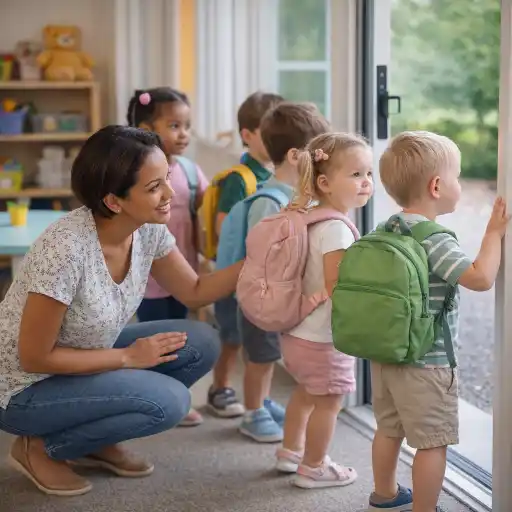
Position adults so the group is covered from front to back and no one is left responsible for watching an unseen area. When staffing permits, one teacher leads, another stays at the rear, and another supports children who need individual help or monitors the doorway. In small groups, maintain the same principles: adults should know who is present, where each child is, and who is covering the route.
- 👀 Scan the starting room, route, and destination—not only the children in line.
- 🔢 State or record the count at agreed checkpoints and compare it with attendance.
- 🧭 Keep children within sight and hearing, adjusting position as the group moves.
- 🤝 Tell colleagues promptly when a child changes location or needs extra support.
- 🚪 Pause the group if the count does not match; retrace the route and follow program procedures.
Do not treat a line as a guarantee of safety. Children may fall behind, move out of sequence, or take a different path. Staff should walk attentively, limit distractions, and listen for changes in the group’s sounds. Applicable supervision expectations may differ by setting and jurisdiction; state requirements vary - check your state licensing agency.
How can transition routines support children’s different needs?
Children do not all process change at the same pace. Some may need extra time to stop a preferred activity; others may find noise, crowding, language, or unpredictable movement overwhelming. A child may also need an individualized cue, a nearby adult, or a planned role that makes the next step concrete. These needs are not failures to cooperate; they are information about how to make the transition more accessible.
Use predictable signals and adapt them thoughtfully. A picture card can show where the group is going; a first–then cue can clarify what happens next; a familiar song can make cleanup more engaging. Offer a brief choice when both options are acceptable, such as “Would you like to carry the book or the schedule card?” A helper task can give a child a purposeful role without making that child responsible for supervising peers.
- Give advance reminders and allow processing time after each direction.
- Break a complex transition into small steps, such as “Put on your coat” and then “Meet at the door.”
- Reduce waiting by moving children in small groups when staffing and the setting permit.
- Use home-language words, gestures, photos, or other communication supports in partnership with families.
- Stay close to children who may wander, become distressed, or need physical assistance.
Keep the safety plan consistent while flexing the support. A child who is upset may need calm acknowledgment and a simplified next step, not a louder or longer instruction. The NAEYC resources on daily routines and classroom transitions offer additional perspectives on creating supportive classroom routines.
What common transition mistakes can teams prevent?
Many supervision gaps arise not from a lack of care, but from assumptions made during a busy moment. One adult may believe another has completed the count; a teacher may focus on the front of the line while the back becomes difficult to see; or the group may reach the destination without checking the original space. Teams can prevent these errors by agreeing on clear roles and checkpoints instead of depending on memory or habit.
- Assuming the headcount is enough: Pair the number with visual, name-to-face confirmation.
- Leaving the rear uncovered: Assign a trailing adult or adjust the group size and positioning.
- Moving before the destination is ready: Prepare the next area first so no adult must leave the group to set up.
- Giving last-second instructions: Use advance warnings and consistent cues.
- Letting distractions compete with supervision: Put away phones and pause nonurgent tasks during movement.
- Rushing a child who needs more time: Build in transition time and plan individualized support.
Directors can reinforce good practice through brief staff rehearsals, visible transition plans, and supportive observations. A simple plan can name staff positions, counting points, communication signals, and what to do if a count is off. Review incidents and near-misses as opportunities to improve staffing, space, and procedures—not to shame individuals.
How can programs make safe transitions a shared practice?
Reliable transitions depend on a whole-team routine that is easy to explain, practice, and adjust. Choose one frequently used transition—such as classroom to playground—and walk through it with staff. Clarify who leads, who follows, where counts happen, how children who need support will be accompanied, and who checks the vacated space. Then practice the routine during a calm period before relying on it during a busy day.
Post concise instructions where staff can see them, including substitutes and floaters. Review the plan when enrollment, room arrangements, staffing, or children’s support needs change. A short debrief can identify whether the group waited too long, whether all children were visible, and what could make the next transition safer and calmer.
Professional learning can help staff turn these routines into confident daily practice. Alongside the courses introduced above, explore Moving About the Classroom: Effective Transitions for Everyday Buy Now $24.00, Effective Supervision in Child Care Buy Now $25.00, and Self-Regulation & Change: Helping Children Cope Buy Now $16.00. These English-language courses address classroom transitions, supervision practices, and supporting children through change. Check course details and your state’s training requirements before enrolling.
Conclusion: What is the key to safe transition supervision?
Safe transitions are planned, active, and responsive. Prepare the route and staff roles; warn children and make the next step clear; keep children in sight and hearing; count at key points and verify each child by name and face; and adapt support to individual needs. These practices protect children while helping them participate in routines and build confidence.
When the count is uncertain, stop and follow the program’s procedures rather than moving on. When transitions are consistently difficult, review the schedule, environment, waiting time, and supports with the team and families. A reliable, practiced system answers the central question—how can teachers supervise children during transitions?—by making every move a shared responsibility, not a moment left to chance.
- Moving About the Classroom: Effective Transitions for Everyday
- Positive Attention: Interactions and Supervision of Infants and Toddlers: For Workforce Solutions
- Mastering Supervision: Keeping Children Safe in All Settings
- Art from the Heart for Preschoolers: Open Ended Art Projects that Build Self-Esteem
- Emergent Learning & Development
- Positive Attention: Interactions & Supervision for Infants & Toddlers
- Creating Environments that Nurture Growth and Community
- Texas Director Credential
- Every Moment Matters: Schedules and Transitions
- Moving About the Classroom: Effective Transitions for Everyday
- Capacitación en Salud y Seguridad Preventiva en Línea para Proveedores de Cuidado Infantil
- Proporciones de Cuidado Infantil y Tamaños de Grupo por Edad en Nueva Jersey (Guía Rápida para Centros y Hogares)
- Proporciones de Cuidado Infantil y Tamaños de Grupo por Edad en Virginia (Guía Rápida para Centros y Hogares)
- Cómo Celebrar el Día Nacional del Kindergarten
- Consejos de Supervisión Activa para Salones de Preescolar y el Juego al Aire Libre
- Found a Building for a Daycare? Read This Before You Sign
- Celebrando la amistad en el cuidado infantil durante el Día de los Mejores Amigos
- Canciones, juegos y preguntas de círculo para niños
- California Preschool Ratios: How Many Children Can One Teacher Supervise?
- Should Child Care Teachers Wake Toddlers From Naps? What Should You Consider?
- Toddler Classroom Management Strategies for the 5 Hardest Parts of the Day
- What Do You Need to Open an After-School Program? Licensing, Training, and Staffing Explained
- Maryland Daycare Ratios: How Many Children Can One Teacher Supervise?
- Active Supervision Examples: 10 Real Classroom Scenarios—Safe or Unsafe?
- Title 22 Home Daycare Ratios: How Age Mix Changes Your California Capacity
- How Many Tantrums a Day Is Normal for a 2-Year-Old?
- What Are Effective Strategies for Managing Nap Time?
- What Should Providers Put in a Classroom Waiting Basket?
- What Are Loose Parts, and How Can Teachers Use Them Safely?
- How Can Child Care Programs Keep Infant Safe Sleep Practices Consistent Across Caregivers?
