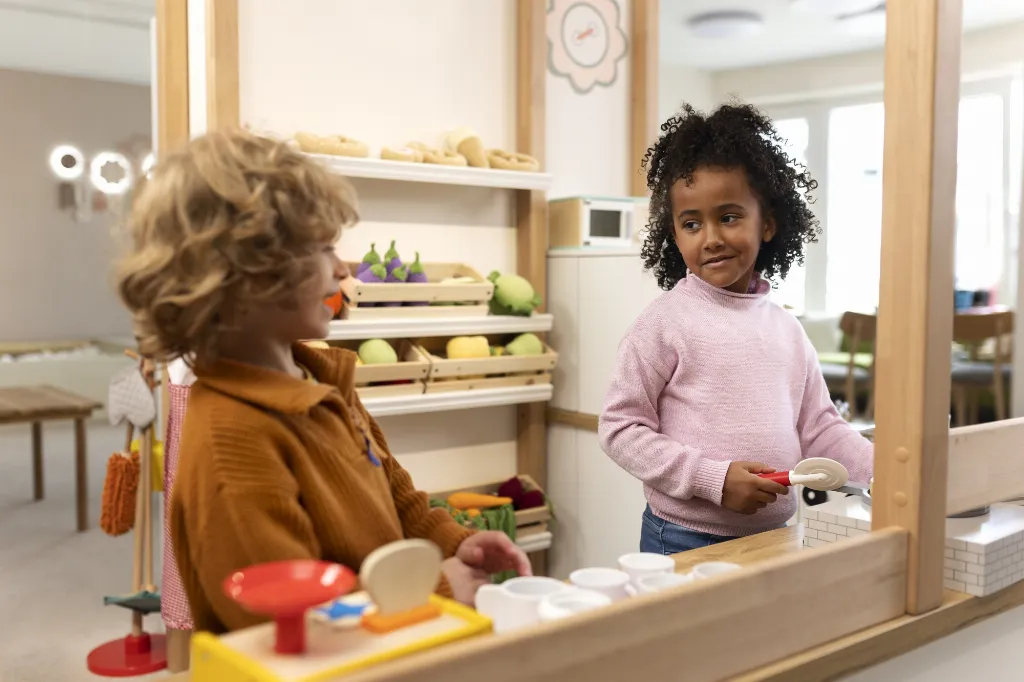
 Grace and Courtesy lessons help children learn to move, speak, and act with respect. These short lessons fit into the daily rhythm of a Montessori room and help make the space calm and kind. This article gives simple ideas for teachers and directors who want practical activities, scripts, and solutions.
What are Grace and Courtesy lessons and why do they matter?
1. Grace and Courtesy are short, taught mini-lessons that show children how to care for themselves, others, and the environment.
2. These lessons include greetings, table manners, how to ask for a turn, how to apologize, and how to move around rugs and shelves. Maria Montessori called these lessons a key part of Practical Life. For a good overview see Peace Education and Grace and Courtesy in Montessori Education. For a broader explanation of Montessori principles and how these Grace and Courtesy lessons fit into the whole approach, see Montessori education.
Why it matters:
- Children learn social skills early. When we teach simple routines, kids feel safe and able to learn. That builds real skills for life.
- Grace and Courtesy support a peaceful classroom culture and help children become kind leaders in their community. You can read how these lessons link to classroom management at Graceful Guidance: Montessori Classroom Management.
How do I teach Grace and Courtesy to different age groups?
1. Infants and toddlers (0–2 years):
- Teach by modeling. Hold babies gently, say greetings, and show how adults wash hands and pass objects. Infants learn by watching. For ideas, see Grace and Courtesy in the Infant Years Buy Now $0.00.
2. Young toddlers (2–3 years):
- Use short demonstrations. Show how to pass a cup, say "please" and "thank you," and how to ask "May I?" Keep it 1–2 steps. Repeat many times.
3. Preschool (3–6 years):
- Teach small group role-plays. Practice greetings, waiting, and walking around rugs. Children can act out scenarios and try scripts. The Practical Life area includes many grace lessons; more background at Practical Life Introduction.
4. Mixed-age rooms:
- Use older children as role models and helpers. Let older kids show younger peers how to carry a tray or roll a rug. Mixed-age benefits and tips are explained in How can Montessori mixed-age classrooms help children.
Quick teaching steps (use every day):
1. Model slowly.
2. Give a clear, simple script.
3. Let a child try while you watch quietly.
4. Praise effort, not perfection.
Repeat often. These short, repeated moments make courtesy part of daily life.
What practical activities, scripts, and tools can I use right away?
Here are hands-on activities you can add this week. Use low shelves, child-size tools, and clear steps. Keep lessons short and concrete.
1. Greeting circle (daily, 2–5 minutes):
😊 Step 1: Gather in a small ring.
🙂 Step 2: Model: "Hello, my name is ___." Children try one by one.
2. Table manners practice (before snack):
🔹 Present one skill at a time: wash hands, sit still, say "please." Use stuffed friends to practice. For table ideas see practical life resources such as Montessori for Everyone free downloads.
3. Peace Corner / Calm area:
🔸 Add a small rug, emotion cards, a mirror, and a soft timer. Teach how to take a break and breathe. ChildCareEd’s Peace Corner resource is helpful: Peace Corner.
4. Scripts to use right away (say these slowly):
1. "May I work here?"
2. "I’m using this. You can try after me."
3. "Please don’t push me. Please use gentle hands."
5. Music and movement lessons:
😊 Use short songs to teach walking around the circle, saying please/thank you, or asking for turns. Musical ideas work well with grace lessons; see music-based classroom ideas at Musically Montessori.
Keep steps small. Use 1–2 minute practices several times a day. Children learn by doing and repeating.
How do I handle conflicts and avoid common mistakes?
1. Use a simple conflict script (teach it and practice it):
- Pause and breathe.
2. Name the problem: "You both want the truck."
- Ask each child to speak (one at a time).
4. Brainstorm 1–2 solutions and agree.
- For a full guide to conflict resolution in Montessori, see What Does Conflict Resolution Look Like in Montessori?.
Common mistakes and how to avoid them:
1. ⚠️ Too many new rules at once — fix: teach 1 skill per week.
2. ⚠️ Over-correcting children — fix: model, wait, and let children try.
3. ⚠️ Not protecting the work cycle — fix: schedule a long, quiet work period each day.
4. ⚠️ Letting older children boss younger ones — fix: give older kids helper roles with scripts.
FAQ
Q1: How often should I teach grace lessons? A: Short daily moments and a weekly small-group lesson work best.
Q2: Can I use these ideas in group care that isn’t fully Montessori? A: Yes. Small changes (modeling, scripts, a peace corner) help any program.
Q3: What if a child won’t follow a lesson? A: Keep modeling, give choices, and celebrate small tries.
Q4: Where can I learn more? A: Look at ChildCareEd courses and free resources linked above. Also consider staff training on classroom management and peace education.
Conclusion:
1. Start small. Pick one short lesson this week (greeting, table manners, or a calm-down routine).
2. Model it, give a script, and let children practice often.
3. Use mixed-age moments and peer helpers where you can. Over time, these little lessons grow into a kinder, calmer #Montessori room full of respectful #children practicing #grace and #courtesy for #peace.
- CDA: A Closer Look at Assessments
- CDA Home Visitor Subject Area 3 Part 3 Birth to 5
- CDA Home Visitor Subject Area 2 Part 3 Birth to 5
- Birth to Five CDA Credential with Portfolio Review
- CDA: Special Needs: Understanding the Whole Child
- Emergent Learning & Development
- 45-Hour Infant and Toddler Curriculum
- CDA: Stand With Respect and Professionalism
- Technology as a Classroom Tool
- Raising Peaceful Learners: The Montessori Advantage
- The Montessori Classroom: A World Designed for Discovery
- The Montessori Advantage in Early Childhood
- ¿Cómo hacer actividades navideñas inclusivas para todas las familias?
- Actividades de Fiesta para Niños de Preescolar y Primaria
- Montessori Social Skills: Grace and Courtesy Lessons
- Grace and Courtesy Activities for Montessori Classrooms
