Children grow on individual timelines, and thoughtful observation helps educators notice both emerging strengths and possible support needs without turning development into a classroom race. The Science of Growing Up: Typical and Atypical Development  Buy Now $55.00 offers a deeper look at milestones, developmental variation, and responsive classroom strategies; it can strengthen your professional knowledge as you support each child’s progress. Read on for practical ways to observe across domains, document what you see, and work with families when questions arise.
Why should teachers treat milestones as guides rather than deadlines?
Milestones describe skills that most children demonstrate by particular ages. They offer educators and families a shared vocabulary for talking about development, but they are not a scorecard for ranking children. The CDC explains that its milestone checklists are communication tools—not developmental standards, screening instruments, or diagnostic tools. A missed item is a reason to notice, ask questions, and consider next steps, not to label a child.
Children’s development is uneven and shaped by temperament, relationships, health, culture, language, experience, and opportunities to practice. A child may communicate richly through gestures while spoken language is emerging, or show strong problem-solving while needing more time with fine-motor tasks. Comparing children in the same group can obscure these individual patterns and may introduce bias.
Michigan’s Early Childhood Standards of Quality emphasize recognizing individual developmental trajectories and expressions of learning. Use standards and milestone resources to plan responsive opportunities, then consider each child’s change over time and performance in different settings.
- Ask, “What can this child do now that they could not do earlier?”
- Notice what conditions, materials, people, or routines help the child participate.
- Discuss differences privately and respectfully; never use a milestone list to rank or shame children.
This strengths-based approach does not mean ignoring concerns. It means acting from evidence and curiosity rather than assumption.
What can teachers observe in language, motor, social-emotional, and cognitive development?
Observe the whole child across play, routines, transitions, outdoor time, and interactions. Domains overlap: language supports peer problem-solving, motor skills influence access to materials, and emotional security can make exploration easier. A single activity rarely shows the full picture.
- Language and communication: Notice words, gestures, signs, facial expressions, comprehension, conversational turns, and how a child communicates in each language they use. For example, a preschooler may retell part of a familiar story, ask for help, or point and look toward an adult to share interest.
- Motor skills: Observe large-muscle movement such as climbing, balancing, running, or catching, as well as small-muscle actions such as drawing, turning pages, using utensils, or manipulating blocks. Consider access to equipment and opportunities to practice.
- Social-emotional development: Watch how the child seeks connection, responds to peers, expresses feelings, copes with transitions, takes turns, and accepts support. A child watching peer play may be participating in a different way than an adult expects.
- Cognitive growth: Look for curiosity, memory, sorting, prediction, persistence, pretend play, and attempts to solve problems. Notice strategies, not only whether the child reaches a correct answer.
Michigan’s Pre-K milestones resource and CDC age-based checklists can provide examples of skills to notice. Use them as conversation prompts, while remembering that no checklist captures every meaningful ability or circumstance.
How can observation notes stay objective and useful?
Good notes make patterns easier to see and help teams plan support. Record what happened, when and where it occurred, who was present, and what happened before or after. Separate the observable facts from your interpretation, and include the support offered and the child’s response. Keep records confidential and follow program procedures.
For example, instead of writing, “Ari is shy and behind in language,” document: “During three small-group play periods this week, Ari watched peers build with blocks. When the teacher offered two choices, Ari pointed to the long block and said ‘that one.’” This note identifies context, communication, and a support that helped, without assigning a label.
A second example: “On Tuesday in the playground, Nia climbed the low steps using the rail, paused at the top, then stepped down with one adult reminder.” This is more informative than “Nia has poor coordination.” Record observations across several days and activities before deciding whether a pattern merits follow-up.
- Include dates and specific words or actions whenever possible.
- Document strengths and successful strategies alongside questions or concerns.
- Compare a child’s current observations with their own earlier observations—not with a peer.
- Review whether language, culture, fatigue, familiarity, sensory conditions, or access to materials may affect what you observe.
NAEYC recommends ongoing, purposeful observation that is developmentally, culturally, and linguistically responsive. Documentation should inform teaching and family conversations, not become a diagnosis.
How can educators support development in everyday classroom practice?
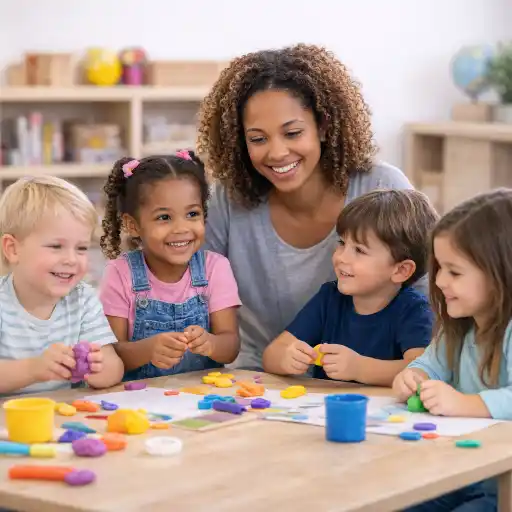
Responsive support starts with the child’s interests and current abilities. Build on what the child already does, offer meaningful practice through play and routines, and adjust the environment or adult support so participation is possible. The goal is not to hurry a child toward a milestone; it is to create conditions for learning and belonging.
- Language: Talk during routines, read together, describe actions, pause for responses, and welcome gestures, home languages, and other communication forms.
- Motor: Offer varied movement experiences, manipulatives in different sizes, safe climbing and balancing opportunities, and sufficient time for self-help tasks.
- Social-emotional: Use predictable routines, name emotions without judgment, model turn-taking language, and help children find ways to join or re-enter play.
- Cognitive: Provide open-ended materials, puzzles, sorting games, pretend play, and questions such as “What could we try next?”
Watch how the child responds and adapt. If a group story is difficult, try a small-group book conversation, visual choices, or a quieter space. If a child struggles with a task, break it into manageable steps while preserving opportunities to make choices independently.
Michigan’s standards encourage early childhood professionals to meet individual and collective needs across backgrounds and experiences. Consistent, inclusive classroom supports are valuable whether or not a child is receiving outside services. Share effective strategies with families so that home and school can reinforce the child’s strengths in ways that fit their routines.
When should teachers raise screening or referral with families?
Educators monitor development; they do not diagnose. Consider a supportive conversation when observations show persistent difficulty participating or communicating across activities, when concerns appear in more than one developmental area, when a child is not gaining skills despite appropriate opportunities, or when the family raises a concern. A loss of previously acquired skills merits prompt discussion with the family and the child’s health care provider.
Begin privately with strengths and concrete examples: “Milo is persistent with puzzles. In several routines, I’ve noticed he often points or takes an adult’s hand to request help, and we hear few words here. What communication do you notice at home?” Ask about the family’s perspective, languages, and strategies that work. Avoid diagnosing, comparing the child with classmates, or implying that a milestone checklist proves a delay.
Explain that developmental screening is a more formal, structured check that can help determine whether further evaluation may be useful. It is not a diagnosis. The CDC notes that families can discuss concerns and screening with the child’s health care provider; screening is also recommended at specific well-child ages, with additional screening when concerns arise.
- With family agreement and according to program procedures, share local referral options. For children under age three, Michigan families can contact Early On Michigan; families of preschool-age children can ask their local school district about evaluation pathways.
- Keep classroom supports in place while a family explores next steps, and set a date to follow up together.
- Protect privacy and document the conversation and agreed actions. State requirements vary - check your state licensing agency.
Conclusion: How can Michigan educators observe without unfairly comparing children?
Michigan preschool teachers can use milestones as useful reference points while recognizing that every child’s development is individual and context-dependent. Observe across domains and settings, write objective notes, notice strengths and effective supports, and track each child’s progress over time rather than comparing children with one another.
When questions persist, partner with families, explain the difference between monitoring and formal screening, and encourage discussion with a health care provider or appropriate Michigan support system. Educators are not expected to diagnose; their careful observations and respectful collaboration can help families decide whether additional screening or evaluation may be helpful. The central goal is to understand each child more fully and make the classroom a place where every child can participate, learn, and thrive.
Helpful ChildCareEd courses
- Typical & Atypical Development in ECE Buy Now $16.00 — explores typical development, possible delays, and inclusive classroom support.
- Developmental Screening in Early Childhood Buy Now $16.00 — reviews screening, assessment, documentation, and collaboration with specialists.
- Tracking Progress, Shaping Futures: Observation & Assessment Skills Buy Now $55.00 — builds skills in objective observation and using information to plan goals.
- Culture, Communication, and Collaboration in Assessment Buy Now $55.00 — focuses on culturally and linguistically responsive assessment and family partnership.
- Preschool Assessments & Observations Buy Now $24.00 — covers observation, appropriate assessment tools, and recognizing when referral may be considered.
- CDA Home Visitor Subject Area 3 Part 3 Birth to 5
- What Makes Me Special: An Overview of Autism and ADHD
- Tracking Progress, Shaping Futures: Observation & Assessment Skills
- Children at the Wheel: Emergent Curriculum
- The Science of Growing Up: Typical and Atypical Development
- Baby Steps to Milestones
- CDA Bridge Bundle: Family Child Care without Portfolio Review
- CDA Bridge Bundle: Infant/Toddler without Portfolio Review
- CDA Bridge Bundle: Preschool without Portfolio Review
- Capacitación Previa al Servicio en Michigan
- CDA Certification en Español: Recursos y Consejos para Educadores Bilingües
- 🔍 ¿Qué ves cuando observas a un niño aprender?
- 💛🧩 ¿Cómo puedo hacer que mi enseñanza sea inclusiva para los niños con autismo?
- 10 Ejemplos de Cómo la Cultura Influye en el Desarrollo Infantil
- Proporciones de Cuidado Infantil y Tamaños de Grupo por Edad en Virginia (Guía Rápida para Centros y Hogares)
- ¿Cuál es la Diferencia Entre la Crianza Respetuosa y la Crianza Permisiva?
- Cómo Celebrar el Día Nacional del Kindergarten
- Apoyo en Preescolar para Retrasos del Habla: Estrategias Simples que Ayudan
- Retraso del Habla en la Guardería: Cómo Pueden Ayudar los Proveedores
- Cómo Trabajar en el Cuidado Infantil en Carolina del Norte: Requisitos y Pasos
- What Signs of Developmental Delays Should Michigan Childcare Workers Watch For?
- How can Michigan childcare and preschool programs support gifted children?
- Celebrando la amistad en el cuidado infantil durante el Día de los Mejores Amigos
- Canciones, juegos y preguntas de círculo para niños
- Cómo simplificar la capacitación para sus empleados de daycare
- When Is Repetitive Speech Typical—and When Should Teachers Pay Closer Attention?
- How Can Providers Explain Different Classroom Expectations to Families with Siblings?
- How Can Michigan Preschool Teachers Support Developmental Milestones Without Unfair Comparisons?
- How Can Michigan Child Care Educators Build a Professional Development Plan That Works?
