When every art project follows the same template, children have fewer chances to test their own ideas, materials, and solutions. These ten process-art invitations help Michigan preschoolers explore color, texture, movement, and self-expression; for a deeper foundation in child-led art practice, explore ChildCareEd’s Open Heart, Open Art  Buy Now $16.00 course, which focuses on open-ended art and its social-emotional value. If you want to strengthen how you plan meaningful, choice-rich experiences across the classroom, the Creating Engaging and Meaningful Learning Experiences Buy Now $55.00 course offers additional practical guidance.
For a ready-to-use companion, the Family-Inspired Process Art Invitations for Preschoolers: 6 Open-Ended Prompts Buy Now $2.00 resource connects art to children’s interests and family experiences.
Why does process art matter for Michigan preschoolers?
Process art centers the child’s exploration, choices, and discoveries—not a finished example everyone is expected to copy. An educator prepares thoughtful materials and a safe space, then lets children decide what to make, how to make it, and when they are finished. This does not mean stepping away from teaching: it means supporting learning without taking over the child’s ideas.
As children mix, press, arrange, build, and revise, they practice fine-motor coordination, descriptive language, problem-solving, persistence, and decision-making. They may also build confidence when adults value their strategies and interpretations rather than judging whether a picture looks realistic. Michigan’s Early Childhood Standards of Quality for Birth to Kindergarten emphasize supporting children’s growth, individual developmental pathways, and varied approaches to learning; open-ended art can offer one responsive context for that work.
For providers, process-focused invitations are also adaptable. A child can participate by watching first, choosing a tool, making one mark, or explaining an idea. The goal is not to produce a wall of matching crafts, but to create repeated opportunities for children to experiment and express themselves.
How can you prepare an art invitation that leaves room for choice?
Start with a small, intentional selection of materials. A crowded table can be overwhelming, while a few contrasting colors, surfaces, and tools invite children to notice what each one can do. Set out materials where children can see and reach them, establish a clear work area, and make cleanup tools part of the routine.
- Offer one short invitation rather than step-by-step instructions: “I wonder what marks these tools can make.”
- Include several ways to participate, such as a vertical surface, larger handles, stabilized paper, or tactile options.
- Use age-appropriate materials, inspect loose parts, and supervise tools and adhesives.
- Plan time for exploration, pauses, and revisiting work; children may need more than one session.
- Keep a photo or short note about the process so families can see the learning behind the artwork.
Michigan classrooms can draw on local seasons and surroundings without making every activity seasonal. A walk near the playground, a view of changing leaves, or the patterns of rain can spark a prompt. Collect natural items only when it is permitted and safe; inspect them for hazards and avoid removing materials from protected areas. State requirements vary - check your state licensing agency.
What paint and color invitations encourage experimentation?
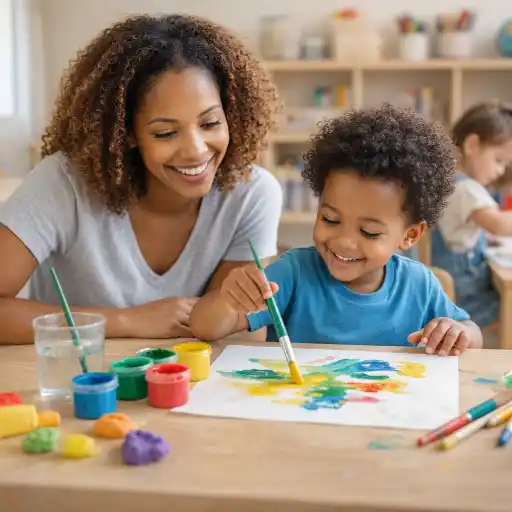
Paint is an ideal medium for exploring cause and effect: children can see how pressure, movement, water, and color change a mark. Present the materials without displaying a model. Invite children to investigate what happens, then allow them to repeat an action or change one variable.
- Color-meeting trays. Put two or three washable paint colors on a tray with paper and mixing tools. Ask, “What do you notice when these colors meet?”
- Unusual-tool painting. Offer sponges, cardboard edges, corks, or large textured tools. Children can compare the marks each tool makes.
- Rolling tracks. Provide washable paint, paper, and sturdy toy vehicles or balls for supervised rolling. Notice lines, curves, speed, and pressure.
- Dropper explorations. Set out colored water, droppers, cups, and absorbent paper or a clear tray. Children can squeeze, drip, overlap, and observe.
- Big-body mural. Secure large paper at a child-friendly height and offer broad brushes. Children can paint with sweeping, dabbing, or circular movements.
These invitations help children explore #colors, movement, and cause and effect while practicing words such as “blend,” “drip,” “light,” and “dark.” Comment on what you see—“You pressed hard and made a thick line”—rather than rating the result.
How can textures and Michigan nature inspire open-ended art?
Texture investigations invite children to notice similarities and differences through touch and sight. Michigan’s varied outdoor settings can offer inspiration—from garden leaves and smooth stones to snow patterns and tree bark—but found materials should be gathered thoughtfully, checked, and used safely. Indoor alternatives work just as well when outdoor conditions or access do not allow collecting.
- Texture rubbing station. Place safe, sturdy textured objects beneath paper and offer crayons on their sides. Children can discover which surfaces make visible patterns.
- Nature arrangement. Set out inspected leaves, seed pods, or small sticks on a tray for temporary designs. Invite children to sort, layer, or rearrange; take a photo before returning materials.
- Open collage. Offer torn paper, fabric scraps, yarn, tissue, and cardboard with an appropriate adhesive. Children choose how to layer and attach pieces.
- Light-and-shadow composition. Provide translucent paper or safe transparent materials near a window or light table. Children can move, overlap, and observe how light changes.
- Clay and loose-parts studio. Offer clay or play dough with larger, age-appropriate natural or manufactured objects to press, imprint, join, and remove.
For every invitation, adapt tool size, surface position, sensory intensity, and communication supports to the children in your group. Some children may prefer to watch before touching; others may communicate their choices with gestures, pictures, or a few words. Inclusion means making meaningful participation possible without requiring everyone to create in the same way.
How can educators support creativity without directing the result?
The educator’s presence matters, but so does restraint. Observe first: notice which materials children select, what they repeat, and where they encounter a challenge. Then decide whether to wait, offer a tool, describe an action, or ask a genuine open-ended question. A thoughtful pause can give a child room to continue thinking.
- Try descriptive comments: “You layered the rough fabric over the smooth paper.”
- Invite children’s thinking: “What are you noticing?” or “What might you try next?”
- Offer a small scaffold when requested, such as holding paper steady or demonstrating how a tool works.
- Avoid correcting a child’s image, finishing the work, or asking every child to explain on demand.
- Document the process with a photo, a child’s words, and a brief observation about strategies or interaction.
Common pitfalls are easy to recognize and adjust. A sample can quietly become a required model; too many supplies can make choices harder; and praise focused only on beauty can imply that appearance is the goal. Instead, describe effort, decisions, and discoveries. Share a simple family note—“The children tested how different tools made different marks”—to make the learning visible. In this way, #process becomes the heart of the art experience, while children’s own ideas remain in the lead.
How can you make these ten invitations part of your weekly routine?
Process art works best as a familiar classroom practice rather than a special event reserved for holidays. Choose one or two invitations at a time, then rotate or adjust them as children’s interests develop. Repeating an activity with one change—new paper, a different tool, or a contrasting texture—helps children deepen their exploration rather than start from scratch every day.
A simple rhythm might include color mixing early in the week, collage or rubbings midweek, and a clay or nature arrangement later. Keep a small documentation record: one photo, a child quote, and a note about a question or skill to revisit. These records can guide the next invitation and help staff reflect together.
Families may be used to take-home projects with recognizable results. Briefly explain that open-ended work prioritizes experimentation, decision-making, and self-expression. Display process photographs alongside children’s words, and invite families to share materials or interests when appropriate. The family-inspired art prompts Buy Now $2.00 can help connect classroom explorations with home experiences while leaving children free to interpret them.
As you plan, align materials and supervision with children’s ages, abilities, and program policies. Michigan’s standards provide a useful state context, but they do not replace program-specific licensing guidance. State requirements vary - check your state licensing agency.
Conclusion: How do templates give way to creative exploration?
Michigan preschool art can nurture creativity when educators provide engaging materials, meaningful choices, enough time, and thoughtful support without prescribing a final product. The ten invitations above offer practical ways to investigate color, texture, movement, nature, and three-dimensional form. Their value lies not in identical finished pieces, but in children’s decisions, experiments, conversations, and revisions.
Begin with one invitation this week. Set out a manageable selection, offer an open prompt, observe before stepping in, and document a moment of learning. When children are trusted to explore, the art table becomes a place to practice expression, persistence, and flexible thinking—one original mark at a time.
Five courses to explore:
- Open Heart, Open Art Buy Now $16.00 — focused on open-ended art and children’s social-emotional development.
- Creating Engaging and Meaningful Learning Experiences Buy Now $55.00 — practical planning for purposeful, developmentally appropriate experiences.
- Environments That Inspire Independence and Exploration Buy Now $55.00 — strategies for inclusive spaces that support curiosity and independence.
- Art from the Heart for Preschoolers: Open Ended Art Projects that Build Self-Esteem Buy Now $35.00 — open-ended art ideas connected to confidence and decision-making.
- Creating Environments that Nurture Growth and Community Buy Now $55.00 — classroom environment and materials planning for belonging and exploration.
Resource: Family-Inspired Process Art Invitations for Preschoolers: 6 Open-Ended Prompts Buy Now $2.00.
- Many Colors, One Canvas: MD ECE Conference
- What Makes Me Special: An Overview of Autism and ADHD
- Power of Art: Bldg Self-Esteem & Positive Behavior for ALL Abilities
- Art from the Heart for Preschoolers: Open Ended Art Projects that Build Self-Esteem
- CDA Bridge Bundle: Preschool without Portfolio Review
- Open Heart, Open Art
- Texas Director Credential
- 45-Hour Infant and Toddler Curriculum
- Montessori Cultural Activities: Exploring the World Through Play and Learning
- Power of Art: Bldg Self-Esteem & Positive Behavior for ALL Abilities ONLINE
- Pencil and Paper Activiites
- Capacitación Previa al Servicio en Michigan
- Tiny Hands, Big Dreams: Fostering Creativity in Preschoolers
- CDA Certification en Español: Recursos y Consejos para Educadores Bilingües
- Cómo Abrir Una Quardería En Casa Sin Dinero?
- Apoyo en Español para Capacitaciones Grupales Presenciales y por Zoom en Cursos Selectos
- Proporciones de Cuidado Infantil y Tamaños de Grupo por Edad en Virginia (Guía Rápida para Centros y Hogares)
- ¿Cuál es la Diferencia Entre la Crianza Respetuosa y la Crianza Permisiva?
- Lista para Abrir una Guardería en Casa en Dakota del Norte: Cómo Empezar
- What are age-appropriate learning activities for infants, toddlers & preschoolers in Michigan?
- Calabazas, hojas y manzanas: actividades de otoño para preescolares
- Celebrando la amistad en el cuidado infantil durante el Día de los Mejores Amigos
- Canciones, juegos y preguntas de círculo para niños
- How can Michigan home-based providers plan engaging and safe summer programming?
- Cómo simplificar la capacitación para sus empleados de daycare
- Preschool Lesson Plans for Learning, Creativity, and Growth
- Free Weekly Lesson Plan for Preschool Classrooms
- What Are 10 Affordable After-School Activities for Michigan Children Ages 5–12?
- How Can Michigan Preschool Art Activities Encourage Creativity Without Templates?
