Introduction
Child care providers and directors: Small hand activities are powerful. Simple tasks like cutting, #pinching, and #threading give children practice with tiny muscles they use for dressing, eating, and writing. This article explains easy activities you can use, why they #matter, and how to keep them #safe and inclusive. Remember: state requirements vary - check your state licensing agency.
What simple activities can I use for cutting, pinching, and threading?
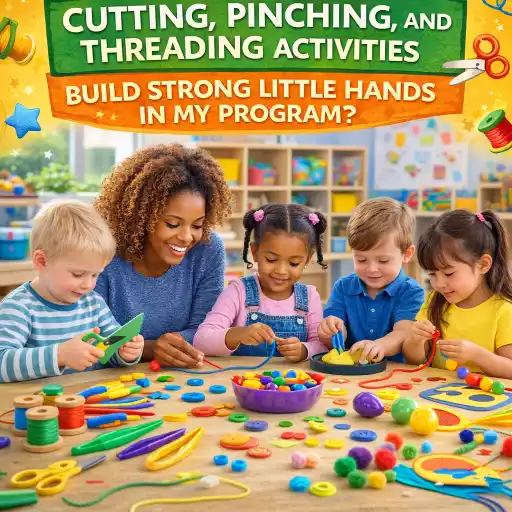
Use low-prep, repeatable activities so children return to them often. Try this numbered #menu you can set up this week:
- 🔪 Scissor strips: wide colored paper strips for early #cutting practice (snips → straight lines). See scissor #development ideas at Growing Hands-On Kids.
- 🧵 Lacing cards: #homemade or printable cards for #threading practice. Lacing builds bilateral coordination as part of fine motor skill work.
- 🔴 Bead and cereal threading: large beads or loop cereal on pipe cleaners or yarn—great for hand-eye work (try variations at Messy Little Monster).
- 🧴 Pinch stations: tweezers, clothespins, or small scoops to move pom-poms or beans—perfect for #pinching practice and quick setup.
- 🎯 Functional games: button boards, hole punch art, or pegboards that combine fine skill and purposeful #play (ideas at ChildCareEd).
Rotate materials to keep interest. Use trays or busy-bag pouches to keep loose pieces tidy and portable.
How do these activities build #handstrength and #classroom readiness?
Small-hand tasks do more than keep children busy. They build key skills #teachers want to see in #preschoolers and kindergarteners. Here’s how:
- 🎈 Muscle strength: squeezing #playdough, pinching clothespins, and using tongs strengthen the hands and thumbs needed for holding a pencil. Research and therapist guides explain that play-based tasks improve hand muscles — see The OT Toolbox.
- ✂️ Tool use: cutting practices (start with snips, then lines, then shapes) teach the open/close motion and helper-hand use.
- 🧠 Coordination and planning: threading and lacing require visual-motor planning and crossing midline—skills that support handwriting and self-care.
- 🤝 Independence: mastering buttoning, zipping, and tying builds confidence and classroom participation (resources on practical life tasks at ChildCareEd).
- 🔁 Endurance and attention: repeated fine tasks improve #focus for table activities like art and learning #centers.
How should I set up stations and avoid common mistakes?
Set up and supervision keep activities safe and useful. Use the checklist below and common-mistake fixes.
- 📋 Prepare labeled stations: 1) Cutting, 2) Threading, 3) Pinching. Limit each station to a few children and rotate every 8–15 minutes.
- 🧰 Choose age-appropriate tools: blunt #safety scissors for #toddlers, lever-style craft punches for older preschoolers, large beads for younger children, and thinner beads for older ones. The scissor development checklist at Growing Hands-On Kids helps match tools to ages.
- 🔍 Supervise and scaffold: sit nearby, show one model, then step back. Use simple prompts: “thumbs up” on scissors, two fingers hold the bead close to the hole for threading.
- ⚠️ Common mistakes and fixes:
- 🛑 Mistake: Tools too small. Fix: Use jumbo beads or larger grips.
- 🛑 Mistake: Too many loose pieces. Fix: Use trays or zip bags and count items out/in.
- 🛑 Mistake: Skipping progression. Fix: Start with snips → straight lines → curves (follow the #developmental steps in How to Teach Cutting).
- 🔐 Safety note: Keep small pieces away from children who still mouth objects and post a reminder that state requirements vary - check your state licensing agency.
How can I include different ages and children with varied abilities?
Different learners need different challenges. Use grading (make tasks easier or harder) and #adaptations so each child succeeds.
- 🔁 Grade up or down:
- Easy: jumbo lacing beads, thick yarn, wide paper strips for #cutting.
- Medium: smaller beads, pipe cleaners, paper with bold lines.
- Hard: tiny beads, narrow shapes, or threading with a blunt needle for older children.
- 🪑 Environmental supports:
- Provide foot support and table height so children sit stable for fine work.
- Offer hand-over-hand modeling briefly, then fade assistance.
- ♿ Adaptations for diverse needs:
- 🎯 Make it purposeful: tie activities to songs, stories, or classroom projects. For #example, thread beads to make a name necklace after learning letters (ideas: Living Life & Learning).
To support your cutting/pinching/threading article with training that builds fine-motor understanding and inclusive activity design, add these two ChildCareEd courses right inside your text:
-
When you explain why these small-hand tasks build readiness (hand strength, coordination, tool skills, and milestones), link 45-Hour Growth and Development (Birth–Age 12) ONLINE here: https://www.childcareed.com/courses-45-hour-growth-and-development-birth-age-12-online.html. (childcareed.com)
-
When you share ideas about adapting materials for different ages and abilities (like modified tools, graded challenges, and inclusive setup), link Open Heart, Open Art here: https://www.childcareed.com/courses-open-heart-open-art.html
 Buy Now $16.00. (childcareed.com)
Conclusion and quick checklist
These hands-on routines help children build the small-hand skills they need for school and daily life. Keep activities short, repeated, and scaffolded. Use clear progression, supervise carefully, and adapt for each child.
Quick checklist for your next session:
- Prepare 3 stations with labeled trays.
- Pick age-appropriate tools and keep backups.
- Model once, prompt briefly, then observe.
- Collect and store pieces in bags for #reuse.
- Note progress; consider OT referral if concerns persist.
FAQ (short):
- Q: How often? A: Daily short sessions (5–15 min) or several times weekly are great.
- Q: When to refer to OT? A: If a child shows very low interest, poor grasp after repeated practice, or major asymmetry, suggest evaluation.
- Q: Can older kids use the same stations? A: Yes — offer harder materials (smaller beads, fine cutting shapes).
- Q: What records to keep? A: Short notes on skill mastered (snips, straight line, circle) help track progress.
Build these simple activities into daily play, and you’ll see stronger hands, better coordination, and more confident children.
- Balancing Physically Active Play in Child Care
- TEAM: Together Everyone Achieves More
- Moving About the Classroom: Effective Transitions for Everyday
- Mind's Medicine: Music in Early Childhood
- Connections That Count: Building Relationships in Child Care
- Texas Director Credential
- Moving About the Classroom: Effective Transitions for Everyday
- How to boost fine motor skills: Holiday Edition
- 👶 ¿Cuáles son las proporciones y grupos requeridos en Dakota del Norte? 🏫
- Cómo Abrir Una Quardería En Casa Sin Dinero?
- Curso de Comunicación de 9 Horas de Maryland
- Mother’s Day Gifts and Crafts Children Can Make
- How can North Dakota classrooms build toddler fine motor skills with simple activities?
- Celebrando la amistad en el cuidado infantil durante el Día de los Mejores Amigos
- National Ice Cream Day: Sweet Activities for Preschoolers
- What toddler development activities can I use in my child care room?
- Pool Noodle Sea Creatures: A Fun Ocean Craft for Preschoolers
- Easy Pool Noodle Sea Creatures for Ocean Theme Activities
- Cómo simplificar la capacitación para sus empleados de daycare
- How can childcare providers support fine motor development with simple activities?
- Can a simple friendship bracelet craft strengthen fine motor skills in your daycare?
- How Can Child Care Providers Strengthen Fine Motor Development Through Play and Daily Routines?
- How Can Child Care Providers Support Early Writing Without Using Worksheets?
- What Should Child Care Providers Look For in Fine Motor Skills by Age?
- How Can Halloween Fine-Motor Activities Be Fun Without Being Scary?
- How Can Child Care Providers Teach Scissor Skills Safely and Developmentally?
- What Skills Come Before Cutting, and When Should Children Learn to Use Scissors?
