Holiday songs can do more than add cheer: with a few intentional motions, they invite children to listen, speak, move, and connect. Explore practical ways to turn Christmas music into language- and coordination-building experiences, and deepen your planning with Mind’s Medicine: Music in Early Childhood  Buy Now $16.00, which helps providers understand musical development and plan appropriate classroom activities. For focused strategies to support children’s communication, explore Language Development in Early Childhood Buy Now $16.00 as a complementary next step.
Why are Christmas music and movement worth planning intentionally?
December can bring joyful anticipation, extra stimulation, schedule changes, and challenging transitions. A familiar song gives children a predictable structure: they can listen for a cue, anticipate what comes next, and participate through voice or movement. When educators connect the lyrics to gestures, music becomes an active learning experience rather than background sound.
Repetition, rhyme, rhythm, and melody create natural opportunities to notice language patterns. Children hear words more than once, practice expressive sounds, and connect vocabulary to concrete actions. A song that asks children to clap, reach, or turn also invites them to coordinate movement with a beat and with peers. Research on structured rhythm-and-movement programs has found benefits in areas such as self-regulation and social behavior, though results from a particular intervention should not be treated as a guarantee for every activity or child.
Keep the goal modest and observable. A short song may invite a child to imitate a gesture, join a repeated phrase, follow a one-step direction, or pause when the music stops. These small moments can support connection and learning without adding a complicated lesson to an already busy season.
How can songs make language learning playful?
Choose a song with a clear refrain, familiar melody, and a small number of useful words. Teach one or two words at a time, pair each with a gesture, and pause at predictable points so children can fill in a word, sound, sign, or movement. Familiar tunes such as “The Wheels on the Bus” or “The Hokey Pokey” can make new seasonal words easier to anticipate.
- Build action vocabulary: Sing about blinking lights, ringing bells, marching reindeer, or falling snow, and demonstrate each verb.
- Play with sounds: Emphasize rhyming words, syllables in children’s names, or repeated sounds in a refrain.
- Invite children to add a verse: Ask what else might jingle, glow, or dance, then help the group put the idea into a short line.
- Use call and response: Sing a short phrase and invite children to echo it or answer with an action.
For example, in a “Lights on the Tree” style song, children can blink their fingers when they hear “lights” and shake gently when they hear “bells.” Accept speech, humming, signing, pointing, and device-assisted communication as meaningful participation. Expand children’s contributions naturally: if a child says “bell,” respond, “Yes, the little bell rings softly.”
Which movements help children practice coordination?
Movement songs can invite children to control their bodies in relation to rhythm, space, and other people. Choose actions that are simple to see and repeat. Clapping, tapping knees, reaching high and low, marching in place, and making small turns let children practice timing and body awareness without requiring complex choreography.
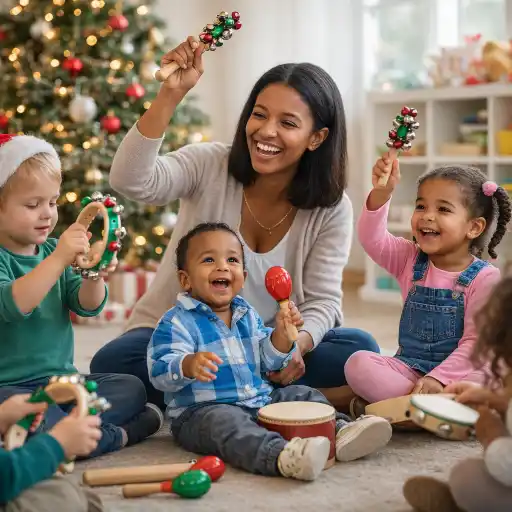
- Reindeer Pokey: Point to antlers, hooves, or a nose, then put the named body part “in” and “out.” This links body vocabulary with controlled movement.
- Jingle-bell beat: Invite children to shake a bell or soft shaker on the beat, then pause when the song pauses.
- Snowflake motions: Float scarves or hands slowly, reach upward, and bend toward the floor as the song changes.
- Freeze-and-listen: Dance gently while music plays and hold a comfortable pose when it stops.
Offer enough room between children, remove trip hazards, and use age-appropriate, intact materials. Keep props light and easy to grasp; supervise closely, especially with small instruments. For toddlers, use gestures and short movements. Older preschoolers may follow two-step patterns, take turns leading, or change movement when the tempo changes. Celebrate effort and experimentation rather than how precisely a child keeps the beat.
How can providers adapt activities for every child and family?
Children bring different movement abilities, sensory preferences, communication styles, languages, and family traditions to the classroom. An inclusive activity offers more than one valid way to join. A child may sing, watch, sway, tap a knee, hold a picture card, or use a communication device. Provide standing and seated choices, and allow children to observe before joining.
Keep volume comfortable and make instruments optional. Use picture cues or objects to preview the song’s actions, and provide a quieter space for a child who needs a break. Instead of asking everyone to perform the same motion, invite children to choose a gesture or lead a verse. These adjustments preserve the shared experience while respecting individual needs.
Christmas is meaningful to some families and not observed by others; families who do celebrate may do so in different ways. Consider your program’s policy and community context. When appropriate, frame activities as learning about a seasonal song or family tradition rather than assuming every child celebrates Christmas. Invite families to share songs, rhymes, or winter traditions in their home languages, and include non-holiday seasonal music as well. This approach supports belonging and helps prevent one tradition from being presented as universal.
How can you plan a short, purposeful music session?
A clear sequence makes music easier to lead during a lively season. Begin with a familiar song, introduce a focused language or movement goal, and finish with a quieter song or cue that helps children transition. One or two songs may be enough for a brief circle-time activity; follow children’s attention rather than stretching the session to fill a block.
- Set one learning intention: For instance, children will imitate an action word or stop safely when the sound ends.
- Choose a suitable song: Look for a repeated refrain, understandable lyrics, and motions that fit the ages and abilities in your group.
- Model and invite: Demonstrate the action, then let children choose how to participate.
- Observe: Notice who anticipates a word, follows a movement cue, communicates a choice, or adjusts movement to the beat.
- Reflect and adapt: Repeat what worked, simplify an action, adjust volume, or add a visual cue next time.
Common pitfalls include introducing too many new songs at once, making the activity too long, treating participation as a performance, or using music without a learning purpose. Repeating a few favorites often gives children more chances to predict, communicate, and gain confidence. Keep the experience joyful and flexible; the aim is meaningful participation, not perfect singing.
How can directors support consistent, thoughtful practice?
Directors can help educators turn holiday music into a manageable part of the curriculum by sharing a small repertoire, discussing safety, and planning adaptations together. A one-page song card can list the song, learning intention, key vocabulary, motions, materials, and participation options. Staff can then adapt the same activity across classrooms while responding to children’s needs.
Brief observations are more useful than judging children’s performance. Educators might note whether a child joined a refrain, matched a motion to a word, waited for a turn, or showed a preference through gesture. Use these observations to guide repetition and offer new challenges when children are ready—not to label a child based on one session.
When selecting songs and props, consider lyrics, cultural context, accessibility, and the physical space. Families can offer valuable insight about children’s home languages and traditions. State requirements vary - check your state licensing agency, particularly for applicable supervision, equipment, and activity-safety expectations.
Conclusion: How can seasonal songs support language and coordination?
Christmas music and movement activities can offer children engaging practice with vocabulary, listening, sound patterns, body awareness, timing, and shared attention. The strongest activities are not necessarily elaborate: a repeated refrain, a clear gesture, a little room to move, and an educator who participates warmly can make a meaningful difference.
Choose one simple goal, offer multiple ways to join, and repeat favorites while observing children’s responses. Make room for families’ varied traditions and provide seasonal alternatives so every child can feel welcome. With thoughtful planning, a few minutes of music can become a joyful opportunity to communicate, coordinate, and connect.
Explore five ChildCareEd courses
- Building Bridges for Dual Language Learners
- Moving About the Classroom: Effective Transitions for Everyday
- CDA Subject Area 2
- Building Bridges for Dual Language Learners: For Workforce Solutions
- What Makes Me Special: An Overview of Autism and ADHD
- Art from the Heart for Preschoolers: Open Ended Art Projects that Build Self-Esteem
- Language and Literacy Foundations in Pre-K
- Building Bridges for Dual Language Learners
- Mind's Medicine: Music in Early Childhood
- Montessori Cultural Activities: Exploring the World Through Play and Learning
- Exploring the Cognitive Benefits of Movement in Early Childhood Classrooms
- How to boost fine motor skills: Holiday Edition
- CDA Certification en Español: Recursos y Consejos para Educadores Bilingües
- 🔍 ¿Qué ves cuando observas a un niño aprender?
- 💛🧩 ¿Cómo puedo hacer que mi enseñanza sea inclusiva para los niños con autismo?
- Actividades de Motricidad Gruesa que Desarrollan el Equilibrio, la Coordinación y la Fuerza
- 10 Ejemplos de Cómo la Cultura Influye en el Desarrollo Infantil
- Actividades de Fiesta para Niños de Preescolar y Primaria
- Proporciones de Cuidado Infantil y Tamaños de Grupo por Edad en Virginia (Guía Rápida para Centros y Hogares)
- Apoyo en Preescolar para Retrasos del Habla: Estrategias Simples que Ayudan
- Retraso del Habla en la Guardería: Cómo Pueden Ayudar los Proveedores
- Canciones, juegos y preguntas de círculo para niños
- How Can Music and Movement Activities Boost Learning and Inclusion for Young Children?
- How Can Low-Prep Christmas Activities Build Preschoolers’ Visual Planning?
- How Can Educators Make Christmas Classroom Activities Optional and Inclusive?
- How Can Child Care Providers Make Christmas Classroom Activities Optional and Inclusive?
- How Can Child Care Providers Create Inclusive Christmas Celebrations for Every Family?
- How Can Christmas Music and Movement Activities Support Children’s Language and Coordination?
- How Can Child Care Providers Teach Christmas, Hanukkah, and Kwanzaa Respectfully?
