Can teaching Día de los Muertos deepen children’s sense of belonging while avoiding stereotypes? With thoughtful planning, you can use this meaningful tradition to strengthen social-emotional learning, family partnerships, and respect for diverse histories. Consider starting with a focused professional course like Teach with Respect ONLINE  Buy Now $24.00 to learn practical strategies for honoring culture in the classroom, and explore family-engagement techniques in Families, Communities, and Classrooms: Working Together for Children Buy Now $55.00 to design events that include families and guard against tokenism.
What is Día de los Muertos and why does it matter in early childhood settings?
Día de los Muertos (often spelled Día de Muertos) is a centuries-old set of practices from Mesoamerican and Mexican traditions that honors deceased loved ones through ofrendas (altars), marigolds, food, stories, and remembrance. Teaching about this holiday can help children practice empathy, vocabulary, and narrative skills, and can validate the cultural identities of Latinx families in your program. When done well,l it becomes a bridge between home and school: children see their family stories acknowledged and classmates learn respectful ways to approach difference. Use the hashtagged concepts below to center your planning: #DiaDeLosMuertos #ofrenda #culture #families #children.
How do I introduce Día de los Muertos to young children in developmentally appropriate ways?
Keep lessons concrete, short, and child-centered. For infants and toddlers, emphasize sensory experiences (smelling marigolds, tasting pan de muerto if families consent), while preschoolers can contribute simple drawings or photos for a class remembrance table. Key practices:
- Start with stories and picture books that represent the holiday faithfully and without exoticizing—bilingual titles work well to support dual language learners.
- Use one simple vocabulary word or idea per activity (e.g., ofrenda = memory table).
- Model emotional language: “We remember people we love and tell stories about them.”
- Plan clear roles and options so participation is never required of children whose families prefer not to be involved.
To sharpen skills for planning respectful, age-appropriate lessons, consider Engaging Indoor Activities for Inclement Weather Buy Now $24.00, which includes strategies for short, rotating stations and sensory supports you can adapt for cultural learning.
How can I involve families and community in an authentic, reciprocal way?
Family partnership is essential. Invite family voices early: ask if they’d like to share a photo, a recipe, a small object, or a short story for a classroom ofrenda. Offer multiple ways to contribute—digital photos, notes, or pre-made items—to reduce pressure. Practical steps:
- Explain your goals and timeline in a simple, translated flyer or a quick phone message.
- Offer an opt-in form for parents who want to help plan or bring items; emphasize that participation is voluntary and optional.
- Host a short family night or an open studio where families can build altars together; pair family sharing with a cultural learning statement that explains meanings (not stereotypes).
- Share follow-up: photos, translations, and a short reflection so families see how their contributions shaped learning.
If you want tools for family engagement and cultural communication, Families, Communities, and Classrooms Buy Now $55.00 provides concrete strategies for assessment, outreach, and respectful inclusion (note: state requirements vary - check your state licensing agency).
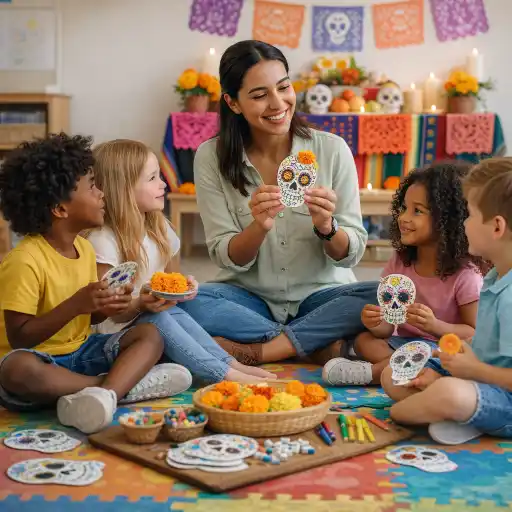
What classroom activities are respectful, educational, and safe?
Choose activities that honor meaning and support developmental goals rather than focusing on costumes or caricature. Activity ideas that map to learning outcomes:
- 🎨 Art: Make paper marigolds or papel picado using templates—fine motor practice and patterning.
- 📚 Story time: Read culturally accurate picture books and ask children to draw a memory of someone they love—supports literacy and social-emotional learning.
- 🍞 Taste-with-consent: If families agree, have a single teacher-prepared, clearly labeled sample like pan de muerto; always follow your allergy and food-prep policies.
- 🪅 Dramatic play: A memory table station with photographs, safe replicas, and writing labels; encourages narrative language and sequencing skills.
Safety and accessibility checks: label items; avoid real candles (use LED tealights); observe sensory sensitivities; and follow food-allergy and supervision rules. For classroom management, transitions, and short-station rotations, the Moving About the Classroom Buy Now $24.00 course offers practical tips for smooth flow and engagement.
How do I avoid common mistakes and respond to accusations of cultural appropriation?
Common mistakes often come from good intentions. Avoid these pitfalls and use them as teaching moments:
- 🚫 Don’t treat cultural symbols as costumes or party props. Avoid sugar-skull makeup or stereotypical dress in ways that reduce meaning to a novelty.
- ⚠️ Don’t single out a child to represent an entire culture; invite family voices and make sharing optional.
- ❌ Don’t commercialize or sell cultural items without community permission or benefit.
How to recover if you misstep: acknowledge the mistake, listen to affected families or staff, and explain how you will do better. Invite community feedback and consider co-creating future events with family or local cultural organizations. For inclusion training that helps you support diverse learners and respond thoughtfully, see Recognize, Respond, Respect: Supporting Diverse Learners Buy Now $55.00. If you need guidance on legal accessibility and inclusive settings, Access for All: Inclusion and the ADA Buy Now $16.00 gives a helpful overview of accommodations and design choices.
FAQ — quick practical answers
- Q: Can non-Latinx staff or families participate? A: Yes, when they approach with curiosity, respect, and a willingness to follow family guidance—avoid portraying the culture as a costume.
- Q: Should we build a classroom altar? A: Yes—if families consent, items are treated respectfully, and participation is optional for children.
- Q: Are sugar skulls appropriate for all ages? A: Use paper templates or play dough versions for toddlers; edible sugar skulls require parental permission and allergy checks.
- Q: How long should activities run? A: Keep stations short (10–20 minutes) for preschoolers and scaffold tasks into manageable steps.
Conclusion
Teaching Día de los Muertos with sensitivity is both achievable and professionally rewarding. By centering family voices, choosing developmentally appropriate activities, avoiding caricature, and using clear communication, you can create learning experiences that honor memory, strengthen community, and build young children’s social-emotional skills. If you want structured, practical training that supports these goals, the ChildCareEd courses linked here—Teach with Respect ONLINE Buy Now $24.00 and Families, Communities, and Classrooms Buy Now $55.00, plus the recommended follow-ups—offer concrete tools to improve classroom practice, build family partnerships, and deepen your professional knowledge. Remember: state requirements vary - check your state licensing agency. With attention to respect and inclusion, your program can celebrate #DiaDeLosMuertos in ways that honor people and support learning.
- Teach with Respect ONLINE
- CDA Home Visitor Subject Area 3 Part 3 Birth to 5
- From Play to Planning: Building Culturally Competent, Child-Centered Curriculum
- Family Voices Matter: Tools for Meaningful Collaboration
- Creating Engaging and Meaningful Learning Experiences
- Texas Director Credential
- Building Bridges for Dual Language Learners
- Wellness in Action: Teaching Healthy Habits to Children
- Bridging Cultures: Family Communication & Collaboration
- CDA Certification en Español: Recursos y Consejos para Educadores Bilingües
- 🌎 ¿Cómo apoyo a las familias diversas mientras honro su cultura y valores? 💜
- 👶 ¿Cuáles son las proporciones y grupos requeridos en Dakota del Norte? 🏫
- Recursos en Español sobre el Sueño Seguro del Bebé
- 10 Ejemplos de Cómo la Cultura Influye en el Desarrollo Infantil
- Cómo Empezar una Guardería en Casa: Requisitos y Pasos
- Proporciones de Cuidado Infantil y Tamaños de Grupo por Edad en Maryland (Guía Rápida para Centros y Hogares)
- Proporciones de Cuidado Infantil y Tamaños de Grupo por Edad en Nueva Jersey (Guía Rápida para Centros y Hogares)
- Proporciones de Cuidado Infantil y Tamaños de Grupo por Edad en Virginia (Guía Rápida para Centros y Hogares)
- Lista para Guardería en Casa en Texas: Cómo Iniciar una Guardería en el Hogar
- Cómo Trabajar en el Cuidado Infantil en Carolina del Norte: Requisitos y Pasos
- Cómo Trabajar en el Cuidado Infantil en California: Requisitos y Pasos
- Cómo Trabajar en el Cuidado Infantil en Wisconsin: Requisitos y Pasos
- Cómo Ser Maestra de Preescolar en Maryland
- Capacitación Previa al Servicio para Proveedores de Cuidado Infantil en Virginia
- Cómo Ser Maestra de Preescolar en Virginia
- Celebrando la amistad en el cuidado infantil durante el Día de los Mejores Amigos
- Cómo simplificar la capacitación para sus empleados de daycare
- How can child care programs celebrate Latin rhythms and culture with young children?
- How Can Child Care Providers Teach Día de los Muertos With Cultural Sensitivity?
