Summer invites children to explore water, sunshine, playgrounds, and new environments—but young children need concrete practice to recognize safer choices. Pair the printable Summer Safety Choices Buy Now $0.25 activity with Injury Prevention: Their Safety Is In Your Hands  Buy Now $24.00 to reinforce classroom instruction while strengthening professional knowledge and supporting applicable training-hour goals.
Why do summer safety lessons need to be playful and explicit?
Children are still developing impulse control, hazard recognition, and the ability to predict consequences. A general reminder such as “be careful” does not tell a child what to notice or do. Effective instruction turns an abstract warning into a brief, observable action: “Ask before going near water,” “Stay where I can see you,” or “Stop, look, and tell.”
Summer safety also matters because outdoor experiences are valuable. The CDC explains that outdoor play supports movement, exploration, social development, and healthy risk-taking, while also requiring intentional attention to sun, heat, insects, playground injuries, germs, and drowning risks. The goal is not to make children fearful or eliminate appropriate challenge. It is to help them participate with increasing awareness while adults remain responsible for supervision.
The Summer Safety Choices Buy Now $0.25 resource offers a simple entry point: children identify and color images showing behaviors such as hydration, sunscreen use, and wearing a life jacket. Directors can use the activity during circle time, small groups, family communication, or staff planning.
How can educators teach children to distinguish safe and unsafe choices?
Begin with a visual sort or picture walk. Present one image at a time and ask, “What do you notice?” followed by, “Is this a safe choice? What could the child do instead?” Avoid rushing to correct children. Their explanations reveal what they understand and provide opportunities to add precise language.
- Safe choice: A child drinks water during active play.
- Unsafe choice: A child remains in direct heat without a break.
- Safe choice: A child asks an adult before approaching water.
- Unsafe choice: A child runs toward a pool or pond alone.
- Safe choice: A child wears a properly fitted helmet while riding.
- Unsafe choice: A child rides near traffic without adult direction.
Use neutral, empowering language rather than labels that shame children. “That choice could hurt your body; let’s find a safer plan” keeps the focus on problem-solving. Invite children to explain their thinking with prompts such as “What makes it safer?” and “Who could help?” Include gestures, photographs, home-language words, and role-play so children with varied communication styles can participate.
🌞 A short phrase such as “Shade, sip, rest” can help children remember heat-related routines without turning the lesson into a lecture.
What water-safety choices should children practice?
Drowning can happen quickly and quietly, so water safety requires constant adult attention. The CDC recommends close, constant supervision, barriers that prevent unsupervised access, and CPR readiness. Swimming ability or formal lessons do not replace supervision.
Teach three consistent rules:
- “Ask first before going near water.”
- “Stay with a grown-up and a buddy.”
- “Wear a life jacket for boats and appropriate natural-water activities.”
Practice with puppets, dolls, picture cards, or dramatic play. One child can act as the water watcher, another as the buddy, and another as the helper who tells an adult when someone needs assistance. Explain that children practice the rules, but adults carry the responsibility for keeping the group safe.
During water play, assign a dedicated watcher who has an unobstructed view and no phone, paperwork, or competing task. Count children before and after transitions. Follow sanitation procedures, and consider sprinklers, hoses, or individual basins rather than portable wading pools. CDC guidance notes that small inflatable or plastic pools should not be used in ECE settings because of drowning and infectious-disease risks.
Revisit the same language before every water activity. Repetition across real routines is more likely to build a usable habit than a single seasonal discussion.
How can providers teach sun, heat, hydration, and insect safety?
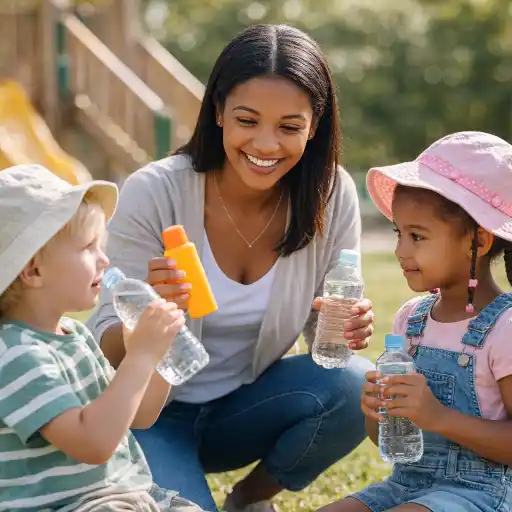
Children often do not recognize thirst or overheating until discomfort is advanced. Create predictable routines before, during, and after outdoor play. Check the forecast, heat conditions, air quality, and UV Index; identify shaded areas; prepare water; and plan rest periods.
- Shade first: Help children identify where they can cool down.
- Sip often: Offer water regularly rather than waiting for children to request it.
- Cover and protect: Encourage lightweight clothing, hats, and protective garments.
- Rest and check: Observe behavior, comfort, and signs of illness.
With written family permission and according to program policy, apply sunscreen as directed. For infants younger than six months, prioritize shade and protective clothing. Follow product labels and local requirements for sunscreen and insect repellent, including age restrictions, allergies, hand hygiene, and documentation.
Teach children to report feeling dizzy, nauseated, unusually tired, or “too hot.” Move a symptomatic child to a cool area, offer fluids when the child is awake and able to drink, follow emergency procedures, and seek medical assistance when symptoms are serious or do not improve. Check playground surfaces, remove standing water where mosquitoes may breed, and inspect children for ticks after outdoor play when relevant to the local environment.
State requirements vary - check your state licensing agency.
How can summer safety learning include playgrounds, transportation, and personal boundaries?
Embed instruction in movement and transitions. Before outdoor play, conduct a brief “safety detective” walk. Invite children to locate boundaries, clear pathways, shade, soft landing areas, first-aid supplies, and the place where staff stand to supervise. This approach builds awareness without portraying ordinary play as dangerous.
For wheeled equipment, use “Helmet on, buckle checked, then ride.” Helmets should fit properly and be removed when riding ends. The CDC and Head Start recommend age-appropriate equipment, impact-absorbing surfaces, guardrails where appropriate, and active supervision.
Field-trip practice can include:
- Walking together and stopping at boundaries.
- Responding to a teacher’s signal.
- Staying within the group’s visual range.
- Carrying water and following sun-protection routines.
- Rehearsing headcounts before departure, upon arrival, and before returning.
Personal safety lessons should be calm and empowering. Teach, “My body belongs to me,” “I can say no, move away, and tell a trusted adult,” and “If I am lost, I stay in one place and ask a helper.” Avoid frightening children with broad messages about strangers; focus on unsafe behavior, trusted adults, and seeking help.
How can directors create consistency across classrooms and families?
Children benefit when every adult uses the same words and routines. Directors can select a weekly focus, brief staff before outdoor play, post visual reminders at children’s eye level, and communicate expectations to families. A practical cycle might include introducing one rule on Monday, modeling it on Tuesday, practicing it during real routines on Wednesday, using a picture scenario on Thursday, and reviewing it on Friday.
Use observations and near misses as opportunities for system improvement, not blame. Ask, “What made this moment difficult?” and “What environmental change would make the safer choice easier?” Review supervision zones, transition procedures, emergency contacts, first-aid access, medication plans, permission forms, and staff assignments.
Helpful professional-learning options include Active Supervision: A Strategy That Works Buy Now $35.00, which addresses watching, listening, monitoring, interacting, and preventing problems; Health and Safety Orientation Buy Now $55.00, which covers hazards, bodies of water, transportation, and emergency planning; Responding to Emergencies Buy Now $16.00, which supports calm response and communication; and 1,2,3, Eyes on Me: Classroom Safety Buy Now $32.00$24.00, which focuses on safe environments and supervision.
Conclusion: What helps children recognize safe and unsafe summer choices?
Children learn summer safety best when instruction is concrete, active, repeated, and reassuring. The goal is not for children to manage risk independently; it is for them to recognize common situations, use simple words or actions, and seek help while adults maintain active supervision.
- Use visual choices, sorting, stories, songs, and role-play.
- Repeat short phrases such as “Ask first,” “Stay where I can see you,” and “Shade, sip, rest.”
- Practice water, heat, sun, playground, transportation, and personal-safety routines in context.
- Pair children’s learning with environmental checks, clear staff roles, and emergency readiness.
- Coordinate expectations with families and verify local licensing guidance.
When safety becomes part of meaningful play, children can enjoy summer exploration while developing practical habits that support health, confidence, and belonging.
Additional ChildCareEd courses to explore:
- CDA Home Visitor Subject Area 3 Part 3 Birth to 5
- CDA Home Visitor Subject Area 2 Part 3 Birth to 5
- Birth to Five CDA Credential with Portfolio Review
- School Age Regs and Professionalism ONLINE
- Creating Engaging and Meaningful Learning Experiences
- Creating Environments that Nurture Growth and Community
- Texas Director Credential
- 10 Hour Health and Safety Orientation Training
- Family Child Care: Building, Premises, and Outdoor Safety
- Ways to Serve: Leadership
- CDA Certification en Español: Recursos y Consejos para Educadores Bilingües
- Recursos en Español sobre el Sueño Seguro del Bebé
- ¿Qué Calificaciones Necesitas para Trabajar en Cuidado Infantil?
- Capacitación en Salud y Seguridad Preventiva en Línea para Proveedores de Cuidado Infantil
- Regulaciones de Licenciamiento de Cuidado Infantil en California para Centros y Hogares de Cuidado Infantil Familiar
- Proporciones de Cuidado Infantil y Tamaños de Grupo por Edad en Maryland (Guía Rápida para Centros y Hogares)
- Proporciones de Cuidado Infantil y Tamaños de Grupo por Edad en Nueva Jersey (Guía Rápida para Centros y Hogares)
- Proporciones de Cuidado Infantil y Tamaños de Grupo por Edad en Virginia (Guía Rápida para Centros y Hogares)
- Lista para Guardería en Casa en Illinois: Cómo Iniciar una Guardería en el Hogar
- Lista para Guardería en Casa en Texas: Cómo Iniciar una Guardería en el Hogar
- Consejos de Supervisión Activa para Salones de Preescolar y el Juego al Aire Libre
- Cómo Trabajar en el Cuidado Infantil en California: Requisitos y Pasos
- Cómo Trabajar en el Cuidado Infantil en Wisconsin: Requisitos y Pasos
- Cómo Ser Maestra de Preescolar en Maryland
- Capacitación Previa al Servicio para Proveedores de Cuidado Infantil en Virginia
- Canciones, juegos y preguntas de círculo para niños
- Cómo simplificar la capacitación para sus empleados de daycare
- How Can Child Care Providers Teach Summer Safety Lessons Young Children Can Remember?
- How Can Child Care Providers Teach Children to Recognize Safe and Unsafe Summer Choices?
- How Can Preschoolers Learn to Make Safer Classroom Decisions?
