When children compare holiday gifts, a simple classroom conversation can quickly touch on money, fairness, family choices, and belonging. Strengthen your approach with Family Connections: Creating Inclusive Relationships  Buy Now $55.00 and Open Ears: Listening in Child Care Buy Now $16.00; these trainings can help you communicate with families respectfully and respond to children with empathy. Read on for practical language and routines that keep the focus on children’s dignity—not the price tag.
Why can gift comparisons feel so significant to children?
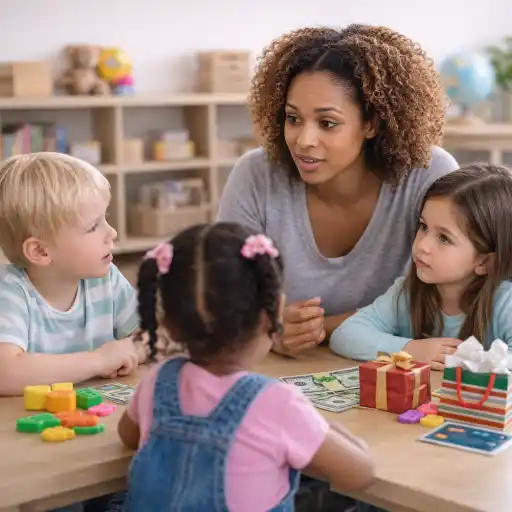
A child may arrive after a holiday eager to tell friends about a new toy, while another child listens quietly or says their family did not exchange gifts. Adults can experience these moments as awkward, but children are often trying to understand what they notice: Why does one person have more? Is that fair? Does receiving a larger gift mean someone is more loved? Their questions deserve calm, honest responses rather than shame or dismissal.
Early childhood is a time when children are developing ideas about fairness and their place in a group. They may not understand family budgets, cultural practices, or the many reasons households make different choices. They do, however, notice visible differences. A thoughtful response helps protect a child’s sense of worth and supports a classroom where belonging is not measured by possessions.
Try to separate a child’s value from what they own. Avoid comments that rank gifts, imply that a family is better or worse, or suggest that every household celebrates in the same way. A useful starting point is: “Families do things differently. The gifts people receive do not tell us how much they are loved.”
As NAEYC’s guidance on holidays in a diverse world reminds educators, traditions vary even among families that observe the same holiday. Some families exchange many gifts, some give one or none, and others do not celebrate that occasion. Treating these differences matter-of-factly helps children feel safe sharing—or choosing not to share—their experiences.
How can educators respond in the moment?
When a child announces, “I got the biggest present,” or asks, “Why didn’t my friend get one?”, begin with curiosity and a steady tone. You do not need to investigate a family’s finances or correct the child’s experience. Acknowledge the observation, set a respectful boundary, and widen the conversation toward relationships, preferences, or kindness.
- “It sounds like you’re excited about your gift. Families choose different ways to celebrate.”
- “We don’t compare what people have. Let’s talk about what you enjoyed doing together.”
- “Some families exchange gifts, and some don’t. Every family can be different.”
- “A gift’s cost doesn’t tell us how much someone cares about you.”
If a child says they feel left out, respond to the feeling before offering a lesson: “That sounds disappointing. I’m glad you told me. What would help you feel included right now?” This shows that the child’s emotion matters without promising to solve family circumstances or criticizing caregivers.
Keep explanations brief and developmentally appropriate. Young children do not need an adult-sized account of household income or inequality during a group conversation. They need truthful language that avoids blame: “Families have different needs and make different choices with their money.” If children ask more, answer simply and invite further conversation with a trusted adult.
Model #kindness in your own language. Do not praise a child for having expensive belongings, tease them about receiving few gifts, or invite the group to vote on whose gift was best. Protect privacy by moving sensitive concerns into a private conversation rather than asking a child to explain their family’s circumstances to peers.
How can classrooms reduce pressure around spending?
Prevention starts with classroom plans. Gift exchanges, “show what you got” circles, and activities requiring families to buy specific materials can unintentionally create pressure or highlight economic differences. Consider whether an activity’s learning goal truly depends on children bringing something from home. Often, it does not.
Instead, create experiences centered on connection and shared participation. Children can make a drawing, dictate a kind note, help prepare a classroom display, or choose a story to share. These options honor children’s creativity without implying that a purchased object is necessary to participate or show affection. As Better Kid Care explains in its holiday celebrations guidance, relationship-focused activities can minimize commercial pressure and keep children’s interests at the center.
- Make any gift exchange optional, with a no-cost classroom alternative for every child.
- Do not require families to purchase supplies, treats, or gifts for classroom participation.
- Offer open-ended materials—paper, blocks, recycled items, or art supplies—provided by the program.
- Use language about family time, traditions, and acts of care rather than asking children what they hope to receive.
- Provide choices for children who prefer not to talk about holidays or family celebrations.
✅ A simple classroom norm can help: “We can share what we choose, and we don’t compare families or belongings.”
These practices also support children whose families are experiencing financial stress, separation, grief, or other changes. Staff do not need to know every detail to offer predictability, a welcoming routine, and an alternative way to join. Consider whether the schedule includes quiet, familiar activities alongside festive events, since extra excitement can be tiring for some children.
How should providers partner with families about these conversations?
Families know their children’s context and values best. If you anticipate a gift-related activity or hear that a child is distressed by comparisons, reach out privately and respectfully. Describe what you observed without making assumptions: “During our conversation, Jordan said they felt left out when gifts came up. We wanted to let you know and ask how you’d like us to support them at school.”
Use a two-way approach. Ask what language or support would feel helpful, listen without judgment, and explain the classroom steps you can take. Avoid asking families to disclose income, defend their holiday choices, or provide gifts to make the classroom experience seem “equal.” The aim is not to make households spend the same amount; it is to ensure every child is treated with dignity.
Program leaders can help by agreeing on consistent practices and preparing staff for sensitive exchanges. A short policy can clarify that participation in gift activities is optional, family information remains confidential, and educators avoid comparing or ranking children’s belongings. Head Start’s resource on preparing for challenging conversations with families recommends planning ahead, listening carefully, and approaching difficult topics as opportunities to build trust.
Invite family perspectives in accessible ways, such as a brief optional survey or a casual conversation, and offer language support when needed. Do not assume that a family’s culture, religion, or financial situation determines how it celebrates. The CDA Council’s inclusive holiday environment guidance likewise encourages educators to plan with families, respect opt-outs, and focus on shared values such as generosity and community.
What common pitfalls should programs avoid?
Good intentions can still create pressure if an activity centers on who brought the most or who received the most. Avoid public gift comparisons, “best present” discussions, and prompts that assume every child celebrates a particular holiday. Do not ask a child to explain why their family did not give gifts or to speak for an entire culture or community.
Another pitfall is treating identical participation as fairness. Giving every family the same purchase request or expecting everyone to contribute in the same way can create unequal burdens. Fairness means providing meaningful, accessible ways to participate without imposing financial expectations. It may mean offering a classroom-supplied alternative, accepting a child’s choice to observe, or adapting the activity for different family preferences.
- Avoid: “What did you get?” as a required group-sharing prompt. Try: “Would you like to share something you enjoyed during your time off?”
- Avoid: implying that a family’s gift choices reveal love or parenting quality. Try: affirming that care is shown in many ways.
- Avoid: asking families to explain private financial circumstances. Try: offering no-cost participation options to everyone.
- Avoid: treating one holiday practice as universal. Try: saying “some families” and acknowledging that traditions differ.
Also avoid overcorrecting by shutting down every mention of a child’s holiday. Children can share meaningful experiences when the conversation remains voluntary and respectful. The goal is neither to celebrate every tradition in the same way nor to silence children; it is to create a space where varied experiences can be acknowledged without turning them into a hierarchy.
When a misstep happens, repair matters. Acknowledge the impact, apologize without defensiveness, and explain what you will change. Then review the activity with colleagues and families so the response becomes part of the program’s learning—not a reason to blame a child or caregiver.
Conclusion: What should children take away from these conversations?
Children should leave conversations about unequal holiday spending knowing that families make different choices, possessions do not measure a person’s worth, and everyone deserves respect. Providers can support this understanding by using calm, honest language; offering alternatives to spending-based activities; protecting family privacy; and partnering with caregivers rather than making assumptions.
The practical goal is not to prevent children from noticing differences. They will. The goal is to help them interpret what they notice without shame, blame, or exclusion. When a child compares gifts, listen for the feeling beneath the words, respond with reassurance, and redirect the group toward connection and shared classroom values.
Choose one action to put in place before the next holiday season: revise a gift-related activity, agree on a respectful sharing prompt, or discuss a consistent response with your team. Small, intentional choices help make the classroom a place where belonging is not measured by what anyone can buy.
For deeper learning, explore Family Connections: Creating Inclusive Relationships Buy Now $55.00, Open Ears: Listening in Child Care Buy Now $16.00, Diversity, Equity, and Inclusion in Education Buy Now $16.00, Family Voices Matter: Tools for Meaningful Collaboration Buy Now $55.00, and Engaging Families for Child Success Buy Now $55.00. These trainings offer further ways to strengthen culturally responsive communication and family partnerships. State requirements vary - check your state licensing agency.
- Beyond the Classroom: Connecting Families to Essential Services
- What Makes Me Special: An Overview of Autism and ADHD
- CDA Family Child Care Credential
- Equity in Action with Head Start
- Positive Attention: Interactions & Supervision of Infants & Toddlers
- CDA Bridge Bundle: Family Child Care
- CDA Family Child Care Credential with Portfolio Review
- Connections That Count: Building Relationships in Child Care
- Bienvenido! Welcoming All Families
- CDA Certification en Español: Recursos y Consejos para Educadores Bilingües
- 10 Ejemplos de Cómo la Cultura Influye en el Desarrollo Infantil
- Capacitación en Salud y Seguridad Preventiva en Línea para Proveedores de Cuidado Infantil
- Cómo Empezar una Guardería en Casa: Requisitos y Pasos
- Regulaciones de Licenciamiento de Cuidado Infantil en California para Centros y Hogares de Cuidado Infantil Familiar
- Proporciones de Cuidado Infantil y Tamaños de Grupo por Edad en Maryland (Guía Rápida para Centros y Hogares)
- Proporciones de Cuidado Infantil y Tamaños de Grupo por Edad en Nueva Jersey (Guía Rápida para Centros y Hogares)
- Proporciones de Cuidado Infantil y Tamaños de Grupo por Edad en Virginia (Guía Rápida para Centros y Hogares)
- Lista para Abrir una Guardería en Casa en Georgia: Cómo Empezar
- Lista para Guardería en Casa en Texas: Cómo Iniciar una Guardería en el Hogar
- Apoyo en Preescolar para Retrasos del Habla: Estrategias Simples que Ayudan
- Retraso del Habla en la Guardería: Cómo Pueden Ayudar los Proveedores
- Capacitación Previa al Servicio para Proveedores de Cuidado Infantil en Georgia
- Capacitación CDA gratuita en Illinois
- Celebrando la amistad en el cuidado infantil durante el Día de los Mejores Amigos
- Diversión fresca de verano: actividades del Día Nacional del Helado para niños
- Canciones, juegos y preguntas de círculo para niños
- Cómo simplificar la capacitación para sus empleados de daycare
- How Can Child Care Providers Strengthen Family Partnerships During Thanksgiving?
- How Can Child Care Providers Handle Conversations About Unequal Holiday Spending?
