A muddy tractor wash can turn children’s love of farm play into meaningful practice with “first, next, then, and last.” Explore a practical way to build sequencing, sorting, language, and self-care into a hands-on fall activity, and deepen your planning skills with ChildCareEd’s Lesson Planning for Preschoolers  Buy Now $24.00 course. The course focuses on lesson-plan components and developmentally appropriate practice, helping you connect playful experiences to clear goals and responsive teaching.
Why does a tractor wash make sequencing visible?
Sequencing is the ability to understand and describe the order in which events happen. For preschoolers, it becomes easier to grasp when they can act out each step rather than only hear a verbal explanation. A muddy tractor wash offers a concrete, repeatable routine: choose a tractor, make it muddy, wash it, rinse it, dry it, and return it to its parking place.
That familiar pattern gives children a reason to use time and order words. As they move vehicles through the stations, educators can model phrases such as “first the tractor drives through the mud,” “next we scrub,” and “last we park it.” Repeating the process helps children anticipate what comes next and notice when a step is skipped or changed.
The theme also invites playful problem-solving. Children may ask whether a muddy tractor needs more water, decide which tool cleans its wheels, or notice that a large vehicle takes longer to dry. Their questions create natural opportunities to extend #sequencing into comparison, prediction, and conversation.
This is not a test of who remembers every step. Children may need visual reminders, adult modeling, or several chances to participate. Keep the experience joyful and collaborative: the learning lies in trying the sequence, describing it, and gradually taking more ownership of the routine.
How can you set up a safe, manageable farm wash?
Keep the setup simple so children spend their time exploring rather than waiting for materials. Use a shallow tub or tray for pretend mud, a separate basin for washing, and a towel or mat for drying. Plastic tractors and washable toy vehicles work well. If real mud is not practical, brown play dough, damp soil in a sealed sensory bag, or brown paper “mud tracks” can provide a dry alternative.
Set up stations in a clear line and use picture cues to show each part of the process. A few tools—such as sponges, soft brushes, small cups, and towels—are enough. Avoid overcrowding the space; duplicate popular tools when possible so children can participate without rushing or conflict.
- Choose washable, age-appropriate vehicles and materials.
- Use shallow water and supervise closely throughout water play.
- Check for small parts, sharp edges, slippery surfaces, and sensitivities to soaps or other materials.
- Keep clean and muddy materials separate, and plan where used water and tools will go afterward.
- 🧽 Offer a dry version for children who prefer not to touch wet or messy materials.
Follow program policies for water play, hygiene, supervision, and cleaning. Children should not drink the water or place shared tools in their mouths. Stay close enough to support safe use of materials while allowing children room to lead their play.
What learning goals can the activity support?
A thoughtful activity can support several areas of development without turning play into a lesson with too many demands. Choose one central goal—such as describing a three-step routine—and let related learning emerge through children’s actions and conversation.
- Early thinking: Children recall, predict, and arrange steps in a familiar process.
- Language: They hear and use words such as muddy, scrub, rinse, dry, before, after, and finally.
- Sorting and early math: They can group tractors by color, size, or type, then match each vehicle to a parking spot.
- Physical development: Squeezing a sponge, pouring small amounts, and scrubbing wheels exercise hand control and coordination.
- Independence: Returning tools and vehicles to their places supports classroom routines and #selfcare.
Ask open-ended questions that invite children to explain their thinking: “What happens before the rinse?” “How will you know this tractor is clean?” “Where should it go when it is dry?” Give children time to respond through words, gestures, pointing, or demonstration. A child’s sequence may be communicated with actions before it is described aloud.
Keep the learning goal observable. Rather than writing “children will understand sequencing,” note what you will watch for: a child names or demonstrates two steps in order, follows a visual sequence, or uses a time word during play.
How can you guide the sequence without taking over?
Begin by introducing the farm story: “The tractors have been working in the fall fields. They came back covered in mud. What might we do?” Demonstrate the routine once using short, clear language, then invite children to choose a vehicle and try it themselves. Picture cards can show mud, wash, rinse, dry, and park, giving children a reference without requiring them to memorize the full routine.
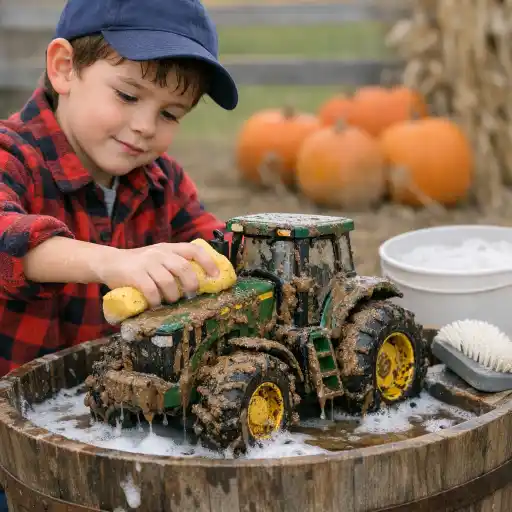
As children play, narrate what you see and gently extend their ideas. “You scrubbed the tires. What might come next?” or “You parked it while it is still wet. Where could it dry first?” These prompts keep children thinking without prescribing every action. If a child repeats one favorite step, join their interest and model the next step when the child is ready.
Offer different entry points. Some children may select and move vehicles; others may scrub, point to a picture, or help with cleanup. Children who are ready for more challenge can arrange the sequence cards independently, explain a reason for each step, or create a new routine for muddy farm animals.
Notice participation rather than comparing children. One child may follow the routine by watching a peer, while another uses words to explain it. Both are meaningful ways to engage. Support children’s #language with repetition and accessible vocabulary, and recognize effort: “You remembered to dry the tractor before parking it.”
How can you observe learning and avoid common pitfalls?
Observation helps you see whether the activity is meeting children where they are. Record a brief, factual note about what a child did or said, rather than making broad judgments from one play session. For example: “After looking at the picture strip, Eli moved the tractor from mud to wash, then asked for the towel.” This note captures a strategy and suggests a possible next step.
Common pitfalls are easy to prevent with a little planning. Too many learning goals can make the activity feel adult-directed; too many stations can create unnecessary waiting; and correcting every variation can discourage children’s ideas. Keep the routine flexible, set out only the tools you need, and treat children’s unexpected approaches as useful evidence of their thinking.
- Choose one primary learning intention and one or two related skills.
- Provide enough time for children to repeat the routine and explore materials.
- Use pictures, gestures, demonstration, and words so children have multiple ways to follow along.
- Observe who needs a prompt, who follows the sequence independently, and what interests children most.
- Plan cleanup as part of the experience, not as an abrupt ending.
Afterward, reflect with your teaching team: Were materials accessible? Did children have enough time? Which cues helped them remember the order? Use the answers to adjust the next invitation. For more structured support in connecting goals, activities, and reflection, explore ChildCareEd’s Lesson Planning for Preschoolers Buy Now $24.00 training. State requirements vary - check your state licensing agency.
Conclusion: How does the muddy tractor wash build sequencing?
A muddy tractor wash makes sequencing practice tangible: children move through a meaningful routine, see the results of each action, and have reasons to describe what happens next. A clear station layout, visual cues, open-ended prompts, and time for repetition help children participate at their own pace while practicing order words, sorting, language, and independence.
Keep the activity focused and responsive. Choose an observable goal, prepare safe and accessible materials, notice children’s strategies, and use what you observe to plan a next step. When a fall farm theme becomes an invitation to think, communicate, and care for materials, even a muddy tractor can drive rich learning.
- 45 Hour Child Growth and Development
- Moving About the Classroom: Effective Transitions for Everyday
- What Makes Me Special: An Overview of Autism and ADHD
- The ABCs of Behavior: Turning Challenges into Learning Opportunities
- Pediatric RSV First Aid & CPR/AED
- Building Equity: Inclusionary Practices in Preschool
- Creating Engaging and Meaningful Learning Experiences
- Texas Director Credential
- CDA Certification en Español: Recursos y Consejos para Educadores Bilingües
- 🌙 ¿Cómo afecta el tiempo frente a las pantallas el sueño y el comportamiento infantil? 😴
- 💛🧩 ¿Cómo puedo hacer que mi enseñanza sea inclusiva para los niños con autismo?
- 👶 ¿Cuáles son las proporciones y grupos requeridos en Dakota del Norte? 🏫
- Recursos en Español sobre el Sueño Seguro del Bebé
- Curso de Comunicación de 9 Horas de Maryland
- Cómo ser director de cuidado infantil en Maryland
- 10 Ejemplos de Cómo la Cultura Influye en el Desarrollo Infantil
- Capacitación en Salud y Seguridad Preventiva en Línea para Proveedores de Cuidado Infantil
- Proporciones de Cuidado Infantil y Tamaños de Grupo por Edad en Maryland (Guía Rápida para Centros y Hogares)
- Proporciones de Cuidado Infantil y Tamaños de Grupo por Edad en Nueva Jersey (Guía Rápida para Centros y Hogares)
- Proporciones de Cuidado Infantil y Tamaños de Grupo por Edad en Virginia (Guía Rápida para Centros y Hogares)
- Cómo Trabajar en el Cuidado Infantil en Carolina del Norte: Requisitos y Pasos
- Calabazas, hojas y manzanas: actividades de otoño para preescolares
- Celebrando la amistad en el cuidado infantil durante el Día de los Mejores Amigos
- Diversión fresca de verano: actividades del Día Nacional del Helado para niños
- Canciones, juegos y preguntas de círculo para niños
- La mejor manera de hacer seguimiento a la capacitación de su equipo de daycare How to Organize Staff Training for Your Child Care Center Cómo organizar la capacitación del personal para su centro de cuidado infantil
- Cómo simplificar la capacitación para sus empleados de daycare
- How Can a Muddy Tractor Wash Turn a Fall Farm Theme Into Sequencing Practice?
