A fever at drop-off can create a difficult decision for any child care professional: protect the group while responding compassionately to one child and family. Illness, Medication, and Allergies in Child Care  Buy Now $32.00 can deepen your knowledge of illness signs, exclusion decisions, and health-related procedures while supporting relevant professional-development goals.
Why does a fever require careful consideration in child care?
A fever is not a diagnosis; it is a sign that the body may be responding to an infection or another condition. In group care, the decision is also influenced by the child’s behavior, ability to participate, staffing capacity, and the possibility of spreading illness. A clear response protects the child without treating every warm forehead or mild symptom as an emergency.
The Child Care Technical Assistance Network’s inclusion and exclusion guidance recommends considering whether the child can participate comfortably, whether the child needs more care than staff can provide safely, and whether the condition creates a meaningful risk to others. This framework helps providers move beyond guesswork and apply the same #policy to every family.
Because licensing and public-health rules differ, state requirements vary - check your state licensing agency. Programs should also review local health-department guidance and keep their written illness policy current.
Can a child with a fever attend daycare?
Generally, a child with a fever accompanied by behavior change or other symptoms should not attend daycare. The CFOC guidance identifies a temperature of 100.4°F (38°C) or higher, taken under the arm or across the forehead in infants and children, with behavior change as a reason for exclusion. The CDC likewise lists fever, particularly when combined with a new rash or other symptoms, among signs that may warrant staying home.
Temperature alone does not tell the whole story. A child who is alert, comfortable, drinking fluids, and participating normally may require a different response than a child who is unusually sleepy, irritable, weak, or unable to join routine activities. Providers should follow the program’s written threshold rather than improvising at the door.
- 🌡️ Confirm the temperature using the program’s approved method and document it.
- Observe behavior, breathing, hydration, appetite, and participation.
- Ask the family whether fever-reducing medication was given and when.
- Apply the same criteria consistently across classrooms and children.
For infants younger than two months, a temperature of 100.4°F or higher requires exclusion and immediate medical attention, whether or not behavior changes or other symptoms are present.
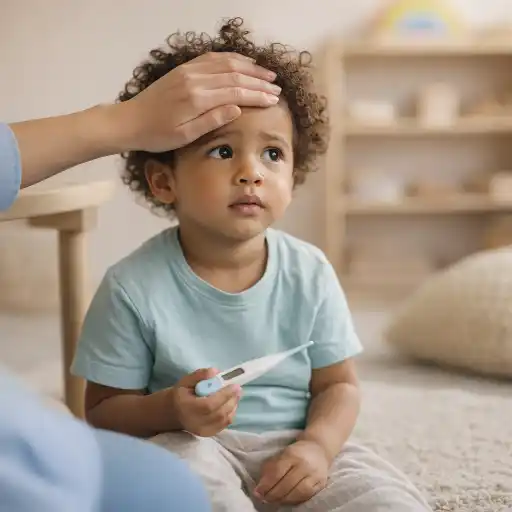
What should staff do when a child develops a fever during the day?
When a child develops a concerning temperature or appears ill, staff should respond calmly and promptly. First, assess whether there is an emergency. Difficulty breathing, unresponsiveness, seizure activity, signs of severe dehydration, or a rapidly worsening condition requires emergency medical action according to program procedures.
If the child is stable but meets exclusion criteria, move the child to a comfortable, designated area away from close group activity. The CDC recommends planning an area for ill children while maintaining adult supervision. A familiar caregiver should remain available, offer reassurance, and monitor the child until an authorized adult arrives.
- Record the time, temperature, measurement method, observable symptoms, and behavior.
- Notify the parent, guardian, or authorized pickup person promptly.
- Explain what was observed without diagnosing or assigning blame.
- Provide fluids or comfort measures only as permitted by policy and the child’s circumstances.
- Document contacts attempted, pickup arrangements, and the time the child leaves.
A useful script is: “We noticed a temperature of 100.4°F and that Maya is unusually tired and not participating. She needs to rest at home. Our policy explains when she may return.” Objective language supports trust and protects confidentiality.
When may a child return after a fever?
Many programs use a return standard of at least 24 hours fever-free without fever-reducing medication. The CDC describes this as a general return-to-school criterion, alongside improving symptoms and the ability to participate. Your program should state the exact requirement in its family handbook and staff procedures.
Counting the time accurately matters. If a child received acetaminophen at 6:00 p.m. and appears well the next morning, the child has not necessarily completed a medication-free, fever-free 24-hour period. Staff should follow the written timeline rather than relying only on appearance at drop-off.
Return decisions should also consider the child’s overall condition:
- The temperature has remained below the program’s fever threshold without medication.
- The child can participate comfortably in ordinary activities.
- Breathing, hydration, and energy are adequate for group care.
- Any additional symptoms meet the program’s return criteria.
A doctor’s note is not automatically necessary for every routine fever. Requiring medical clearance for ordinary illnesses may create financial and logistical burdens for families. However, diagnosed or reportable conditions may require specific public-health instructions or documentation. Follow applicable rules rather than applying one blanket requirement.
How can programs prevent fever-related illness from spreading?
Exclusion is only one layer of prevention. The CDC recommends combining staying home when sick with hand hygiene, cleaning and disinfection, separated personal belongings, ventilation, vaccination support, and a supervised area for symptomatic children. These practices reduce exposure even when the exact illness is unknown.
Staff should wash hands with soap and water for at least 20 seconds at key times, including arrival, before meals, after toileting or diapering, and after contact with respiratory secretions. Clean and disinfect high-touch surfaces and objects contaminated by body fluids according to product instructions, including required contact time. Improve ventilation when feasible and keep each child’s belongings separate.
Directors can strengthen implementation by:
- Reviewing the illness policy during orientation and annual refreshers.
- Posting a short family handout with exclusion and return rules.
- Keeping thermometers, gloves, documentation forms, and emergency contacts accessible.
- Auditing illness records for patterns across classrooms.
- Contacting public health when several children or staff develop similar symptoms.
Avoid common mistakes such as diagnosing a child, hiding symptoms from families, using inconsistent thresholds, or allowing fever-reducing medicine to mask illness for attendance. Compassion and consistency can coexist: families deserve clear expectations, and children deserve comfort and dignity.
Conclusion: Can a child come to daycare with a fever?
A child with a fever should generally stay home when the temperature is accompanied by behavior change, other symptoms, or an inability to participate comfortably. For infants younger than two months, a temperature of 100.4°F or higher requires exclusion and immediate medical attention. When a child develops a fever at daycare, supervise the child in a separate, comfortable area, contact the family promptly, document objective observations, and follow emergency procedures when necessary.
Return is commonly allowed after the child has been fever-free for at least 24 hours without fever-reducing medicine and is well enough to participate, but local rules may differ. A strong program combines clear criteria with respectful communication, infection-control routines, and regular staff training.
- How To Keep A Healthy Class: Six Tips for Germ Control
- Illness, Medication, and Allergies in Child Care
- Adult Only CPR AED and Adult First Aid Blended
- CDA Family Child Care Credential
- Birth to Five CDA Credential with Portfolio Review
- CDA Family Child Care Credential with Portfolio Review
- Texas Director Credential
- Daycare illness guide: when to keep your child home
- CDA Certification en Español: Recursos y Consejos para Educadores Bilingües
- 💛🧩 ¿Cómo puedo hacer que mi enseñanza sea inclusiva para los niños con autismo?
- Cursos De Daycare En Español
- Curso Para Trabajar En Daycare:Qué Necesitas Para Empezar
- Cómo Abrir Una Quardería En Casa Sin Dinero?
- North Dakota Daycare Sick Policy: Fever, Vomiting, and Return-to-Care Rules
- 10 Ejemplos de Cómo la Cultura Influye en el Desarrollo Infantil
- Cómo Iniciar el Proceso de Obtención de la Licencia de Cuidado Infantil
- Cómo Empezar una Guardería en Casa: Requisitos y Pasos
- Proporciones de Cuidado Infantil y Tamaños de Grupo por Edad en Maryland (Guía Rápida para Centros y Hogares)
- Proporciones de Cuidado Infantil y Tamaños de Grupo por Edad en Wisconsin (Guía Rápida para Centros y Hogares)
- Proporciones de Cuidado Infantil y Tamaños de Grupo por Edad en Nueva Jersey (Guía Rápida para Centros y Hogares)
- Proporciones de Cuidado Infantil y Tamaños de Grupo por Edad en Virginia (Guía Rápida para Centros y Hogares)
- Lista para Guardería en Casa en Illinois: Cómo Iniciar una Guardería en el Hogar
- Cómo Trabajar en el Cuidado Infantil en Wisconsin: Requisitos y Pasos
- Celebrando la amistad en el cuidado infantil durante el Día de los Mejores Amigos
- Cómo simplificar la capacitación para sus empleados de daycare
- Can a Child Come to Daycare With a Fever?
