


$1.50 One-time license · lifetime download access
Buy Now charges your payment method right away — the resource appears under My Resources. Or add it to your cart and check out together with trainings.
Highlights
GradesSchool Age
Pages8
TypePDF
SourceChildCareEd
Price$1.50 License available
License: ChildCareEd Resource License
Description
This 8-page teacher reading guide helps children identify details that support an informational passage’s main idea and distinguish them from interesting extra information. Use the read-aloud and small-group prompts to model thinking and invite children to point to text evidence. The practical test—whether a detail helps explain what the passage is mostly about—gives educators a clear way to guide discussion during literacy lessons.
Other items you may like

PDF
Main Idea Detectives: Teacher Reading Guide for Main Idea and Supporting Details
Use this six-page teacher reading guide during a read-aloud or small-group lesson to introduce main idea and supporting details. The guide explains the skill in student-friendly language and models... Read more
6 pages
$1.50 Available for purchase
License: ChildCareEd Resource License

PDF
Dinosaur Measurement Detective: Teacher Guide and Answer Key
This teacher guide and answer key prepares you to introduce companion dinosaur measurement activities, with beginner or advanced supports and guidance for checking children’s answers. Children pr... Read more
12 pages
$1.49 Available for purchase
License: ChildCareEd Resource License

PDF
Station Time: Teacher Guide and Answer Key for Reading Clocks
This teacher guide supports the three-station railway workbook with preparation and facilitation notes plus verified answers for checking children's work. Use it alongside the children's workbook p... Read more
10 pages
$2.00 Available for purchase
License: ChildCareEd Resource License

PDF
Space Literacy Workbook Teacher Guide and Answer Key
This teacher guide provides facilitation notes and suggested answers for three space-themed workbook activities: scrambled sentences, grammar detective, and finish-the-space-story. Use the guidance... Read more
11 pages
$1.85 Available for purchase
License: ChildCareEd Resource License

PDF
Detective Workbook Guide and Answer Key: Secret Codes, Logic Clues, and Sequences
This teacher guide supports three companion detective workbook activities with instructions, worked examples, puzzle checks, and an answer key. Children practise decoding number-to-letter messages,... Read more
11 pages
$1.50 Available for purchase
License: ChildCareEd Resource License

PDF
Junior Detectives: The Mystery of the Missing Lunchbox | Mystery-Solving Teacher's Guide for Ages 6–12
Lead children ages 6–12 through a fictional classroom mystery about a missing lunchbox with this teacher’s guide. Prepare character and clue cards, a story sheet, pencils, and an evidence chart... Read more
21 pages
$1.75 Available for purchase
License: ChildCareEd Resource License

PDF
Context Clue Detectives: Teacher Vocabulary Guide and Activities
This 7-page printable guide introduces four types of context clues and models how surrounding text can reveal an unfamiliar word’s meaning. Children practice rereading, spotting clues, making a m... Read more
7 pages
$1.50 Available for purchase
License: ChildCareEd Resource License

PDF
Christmas Word Detective Teacher Guide: Holiday Word Searches and Spelling Puzzles
This teacher guide provides a flexible routine for Christmas literacy activities, including beginner word searches, scrambled-word puzzles, and missing-letter challenges with picture and context cl... Read more
12 pages
$2.50 Available for purchase
License: ChildCareEd Resource License

PDF
The Decimal Detective: A Teacher’s Guide to Decimal Place Value (Ages 6–12)
This teacher’s guide helps educators introduce decimal place value to learners ages 6–12 through a sequence that moves from concrete models to real-world problems. Children explore tenths and h... Read more
13 pages
$1.75 Available for purchase
License: ChildCareEd Resource License

PDF
Story Detective Files: Teacher Story Elements Guide
Use this five-page guide to teach children how to identify character, setting, problem, and solution in a short story. It includes clear explanations, a teacher think-aloud prompt, and the example ... Read more
5 pages
$1.50 Available for purchase
License: ChildCareEd Resource License

PDF
Reindeer Reading Workbook Teacher Guide: Christmas Story Comprehension
This teacher guide supports instruction and comprehension tracking for a companion workbook featuring five original Christmas adventures about Santa’s reindeer. Use its preparation and teaching s... Read more
18 pages
$3.00 Available for purchase
License: ChildCareEd Resource License

PDF
New Year's Math Workbook Teacher Guide and Answer Key
This teacher guide supports three New Year’s math workbook activities, with preparation tips, directions for independent pencil-and-crayon work, and an answer key. Children practise number tracin... Read more
14 pages
$2.65 Available for purchase
License: ChildCareEd Resource License
PDF
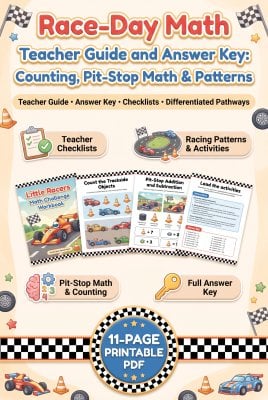
Race-Day Math Teacher Guide and Answer Key: Counting, Pit-Stop Math & Patterns
This teacher guide pairs with three race-day child activity pages and includes preparation checklists, activity notes, differentiated beginner and advanced pathways, and an answer key. Children pra... Read more
11 pages
$1.85 Available for purchase
License: ChildCareEd Resource License

PDF
Syllable Express Teacher Guide and Answer Key: Syllable Counting
Use this teacher guide to model how children hear and clap syllables during daily literacy instruction. It includes demonstration steps, prompts, correct placements, and an answer key for the three... Read more
10 pages
$1.85 Available for purchase
License: ChildCareEd Resource License

PDF
Reading Food Labels: Teacher Guide to Nutrition Facts
Use this teacher guide to introduce food labels and model how to read Nutrition Facts panels with children. Learners practice identifying serving sizes, ingredients, calories, sugar, sodium, protei... Read more
10 pages
$1.50 Available for purchase
License: ChildCareEd Resource License

PDF
Every Reader Matters: A Teacher’s Guide to Accessible Reading Instruction for Ages 6–12
This 10-page guide helps educators plan explicit, flexible reading instruction for children ages 6–12, with guidance on phonemic awareness, phonics, decoding, fluency, vocabulary, and comprehensi... Read more
10 pages
$1.75 Available for purchase
License: ChildCareEd Resource License

PDF
Read Between the Lines: A Teacher Guide to Modeling Inference-Making
This 9-page guide helps teachers introduce inference-making by modeling how to notice clues, connect them to prior knowledge, and state a reasonable inference. Its clear “Clues + What I Know = In... Read more
9 pages
$1.75 Available for purchase
License: ChildCareEd Resource License

PDF
The Little Math Detectives: A Teacher’s Guide to Observation and Reasoning (Ages 3–5)
This teacher’s guide for ages 3–5 offers playful, gradually scaffolded ways to help children investigate missing objects, spot differences between pictures, compare groups, and match objects to... Read more
13 pages
$1.75 Available for purchase
License: ChildCareEd Resource License

PDF
The Number Pattern Detectives: A Teacher’s Guide to Factors and Multiples (Ages 6–12)
This teacher’s guide lays out a hands-on lesson progression for learners ages 6–12, from building arrays and identifying factor pairs to skip-counting multiples and exploring common factors and... Read more
13 pages
$1.75 Available for purchase
License: ChildCareEd Resource License

PDF
Question Word Detectives: Teacher Guide to Who, What, When, Where, Why, and How
This 6-page teacher guide introduces the question words Who, What, When, Where, Why, and How, explaining the information each one asks for and providing classroom examples. Educators can use the sa... Read more
6 pages
$1.50 Available for purchase
License: ChildCareEd Resource License
