A one-year-old learns through relationships, movement, repetition, and joyful exploration—not worksheets or formal lessons. To strengthen your team’s ability to plan responsive experiences, explore Playful Learning: Infant & Toddler Activities Buy Now $25.00, which can help providers design age- and ability-appropriate classroom experiences while building professional knowledge and training hours.
Why does learning at age one look different from traditional teaching?
At one year, learning is embedded in ordinary moments: greeting a caregiver, reaching for a toy, listening to a song, practicing a cup, or searching for a hidden object. The goal is not to accelerate children into preschool academics. Instead, effective daycare practice creates secure relationships and inviting opportunities for children to act, communicate, investigate, and try again.
The CDC describes developmental milestones as skills that most children—at least 75 percent—can do by a given age. Milestones are useful observation points, not rigid deadlines. Children develop at different rates, and prematurity, disability, temperament, culture, language, and prior experiences all influence how learning appears.
For providers, this means planning should be intentional but flexible. A high-quality #classroom offers predictable routines, responsive adults, safe materials, and repeated chances to practice skills. Purdue’s ELM curriculum similarly organizes infant-toddler learning across communication, cognition, self-regulation, social-emotional development, and physical health. For a broader look at how relationships, curriculum, environments, and staff qualifications contribute to high-quality daycare, see this guide.
- Learning is active: children touch, move, listen, imitate, and experiment.
- Relationships are instructional: warm back-and-forth interactions support communication and regulation.
- Care routines are curriculum: diapering, meals, rest, and transitions provide meaningful practice.
Which developmental skills should a one-year-old be practicing?
By one year, many children are beginning to pull to stand, cruise along furniture, use a pincer grasp, wave or use other gestures, imitate actions, search for hidden objects, and engage in simple social games. The CDC’s one-year milestone guidance is an appropriate reference for discussing development with families.
Providers can organize observations into several connected domains:
- Physical development: crawling, standing, cruising, taking steps, grasping, releasing, banging, stacking, and carrying.
- Communication: babbling, responding to names, pointing, waving, making sounds, and attempting familiar words.
- Cognitive development: exploring cause and effect, finding hidden objects, copying actions, and solving simple problems.
- Social-emotional development: showing preferences, seeking familiar caregivers, participating in peek-a-boo, and beginning to express emotions.
- Self-help skills: finger-feeding, holding a cup with assistance, helping during dressing, and participating in handwashing.
These domains overlap. A child dropping a ball into a container is using fine-motor coordination, visual attention, problem-solving, persistence, and perhaps language when an adult narrates the action. Avoid teaching each domain in isolation; instead, design experiences that invite several kinds of learning at once.
What play experiences build movement, thinking, and sensory skills?
One-year-olds benefit from open-ended materials that invite repeated action. Simple objects are often more useful than toys that perform every step for the child. Providers can offer baskets, large blocks, soft balls, nesting containers, board books, scarves, cups, wooden spoons, and sturdy push toys, provided materials are safe and developmentally appropriate.
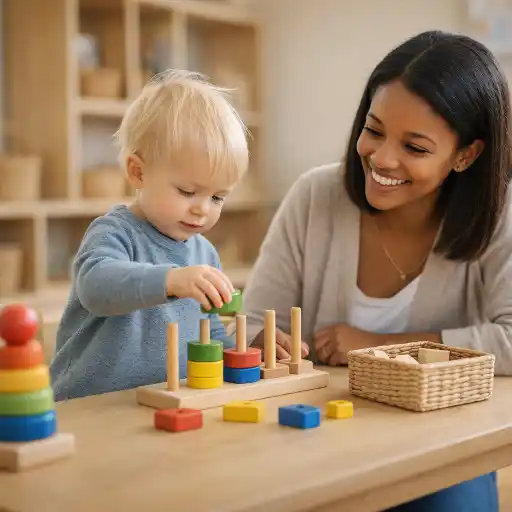
- 😀 Fill and dump: Offer large soft objects and two containers. Children practice grasping, releasing, visual tracking, and early problem-solving.
- 📚 Book exploration: Provide books with flaps, textures, or clear photographs. Let children turn pages, point, mouth safe books, and return to favorite images.
- 🧸 Movement paths: Arrange stable furniture, cushions, and toys to encourage crawling, pulling up, cruising, and reaching. Never require walking before a child is ready.
- Cause-and-effect play: Provide containers, balls, drums, or push-button toys that allow children to observe what changes when they act.
- Supervised sensory play: Use water, sealed texture bags, or large washable objects. Avoid loose materials that create choking hazards.
ZERO TO THREE recommends activities such as leaf collecting, freeze dancing, shadow play, filling and dumping, pouring, bubbles, and naming body parts. Adapt these ideas for group care, maintain close supervision, and follow sanitation procedures. Screen exposure should not replace interaction; the CDC notes that children younger than two learn best through talking, playing, and engaging with people.
How should a daycare team plan and document learning?
Planning for one-year-olds works best as a short cycle: observe, identify a strength or interest, offer a modest challenge, and document what happened. A one-page weekly plan can include one or two goals, materials, a few interaction strategies, and a space for observations.
- Observe: Watch how the child approaches people, materials, movement, and routines.
- Interpret: Ask what the behavior may communicate and which developmental domain it reflects.
- Respond: Add language, adjust the environment, model an action, or provide more time.
- Record: Write objective notes such as, “Maya placed three blocks in the basket after watching the teacher,” rather than “Maya did well.”
- Reflect: Use the observation to plan the next invitation and share meaningful information with the family.
Keep experiences brief and repeat them often. A child may engage for only a few minutes, and that is developmentally reasonable. Avoid overloading the room with materials; two to four carefully chosen objects can support deeper exploration than a crowded shelf.
Documentation should support partnership, not comparison. Share strengths, interests, and concrete examples with families. Ask what the child does at home and incorporate familiar songs, words, foods, and comfort objects when appropriate. State requirements vary - check your state licensing agency.
When should providers share developmental concerns?
Concern is not a diagnosis, and a missed milestone alone does not determine a child’s future. However, providers should act promptly when a child loses skills, shows persistent difficulty across settings, or is not demonstrating expected communication, social, motor, or adaptive behaviors. The CDC encourages families and professionals to act early rather than wait when concerns arise.
Use a respectful, evidence-based process:
- Document specific observations with dates, contexts, and examples.
- Review the information with a supervisor and consider whether environmental, language, cultural, sensory, or health factors may be relevant.
- Speak with the family privately, beginning with strengths and using neutral language.
- Encourage the family to consult the child’s health care provider and ask about developmental screening.
- Share information about the state’s early intervention system when appropriate, with the family’s participation.
Possible concerns can include limited babbling or gestures, little response to sounds or people, substantial difficulty with movement, unusual reactions to sensory experiences, or loss of previously acquired skills. These observations should never be used to label a child. They are signals to gather information and connect the family with qualified professionals.
Common mistakes include comparing children publicly, waiting for a child to “catch up” after skills are lost, presenting concerns as certainty, or separating families from the process. A strengths-based conversation protects dignity while supporting timely action.
Conclusion: What should a one-year-old be learning at daycare?
A one-year-old should be learning through safe exploration, warm relationships, movement, communication, sensory discovery, early problem-solving, and participation in everyday routines. The most effective daycare curriculum is not a collection of academic drills; it is a responsive environment where adults notice children’s cues, extend their interests, and provide repeated opportunities to practice.
Use milestone guidance as a tool for observation, not a rigid scorecard. Plan short play invitations, narrate care routines, read and sing daily, protect active movement, document objective observations, and collaborate with families. For continued professional growth, consider Baby Steps to Milestones ONLINE  Buy Now $24.00, Playing with a Purpose: Infant/Toddler Lesson Planning Buy Now $24.00, Positive Attention: Infants and Toddlers Buy Now $24.00, and Playful Spaces for Infants & Toddlers Buy Now $24.00. Together, these options can strengthen observation, planning, interaction, and environment design.
Your calm presence is one of the most powerful learning materials in the room. Small, repeated moments of connection and discovery help one-year-olds build the confidence and skills they will carry forward.
- CDA Certification en Español: Recursos y Consejos para Educadores Bilingües
- How Old Do You Have to Be to Work at a Daycare?
- 😫🧸 ¿Qué hacer cuando un bebé no quiere dormir la siesta en el aula?
- 👶 What Child-to-Staff Ratios and Group Sizes Are Required in North Dakota Childcare? 🏫
- ¿Cuál es la diferencia entre un certificado CDA y la credencial CDA?
- Regulaciones de Licenciamiento de Cuidado Infantil en California para Centros y Hogares de Cuidado Infantil Familiar
- Lista para Guardería en Casa en California: Cómo Iniciar una Guardería en el Hogar
- Daycare Jobs in Illinois: How Old Do You Have to Be?
- Daycare Jobs in Nevada: How Old Do You Have to Be?
- Daycare Jobs in Georgia: How Old Do You Have to Be?
- Daycare Jobs in California: How Old Do You Have to Be?
- Daycare Jobs in Wisconsin: How Old Do You Have to Be?
- Daycare Jobs in Virginia: How Old Do You Have to Be?
- Daycare Jobs in Maryland: How Old Do You Have to Be?
- Daycare Jobs in North Carolina: How Old Do You Have to Be?
- Celebrando la amistad en el cuidado infantil durante el Día de los Mejores Amigos
- Nevada Child Care Ratios and Group Sizes by Age: Home Daycare Guide
- Washington Child Care Ratios and Group Sizes by Age: Home Daycare Guide
- How Old Do You Have to Be to Start Working in Daycare?
- How Can Daycare Providers Find Grants That Are Still Open in 2026?
