When an older infant drops a toy into a container, retrieves it, and repeats the experiment, that joyful “again!” is more than a game—it is early learning in motion. Build safe, purposeful autumn play with the Baby Play: Planning Infant and Toddler Activities  Buy Now $16.00 course, which can help you plan individualized experiences that support infants’ development and strengthen your classroom practice. Keep reading for practical ways to turn a few sturdy containers into a fall invitation that respects babies’ curiosity and need for close supervision.
Why is drop-and-find play meaningful for older infants?
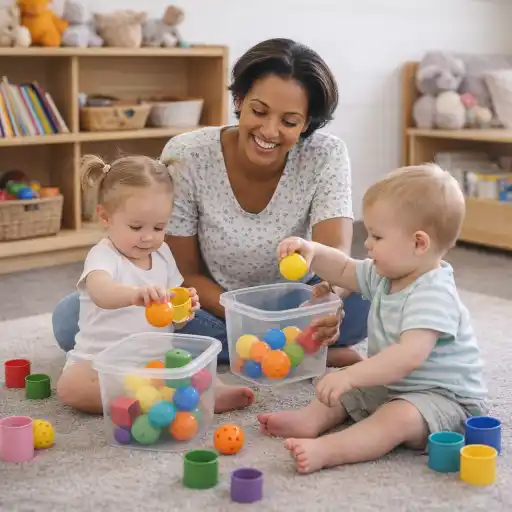
Older infants learn by acting on objects and noticing what happens. When a baby drops a large object into a container, peers inside, reaches for it, and repeats the sequence, the child is exploring cause and effect, movement, and the persistence of objects beyond immediate view. The familiar cycle—drop, search, retrieve, try again—offers a baby control over the pace and repetition.
These discoveries are not a formal test of development. They are opportunities to practice attention, hand-eye coordination, grasping, reaching, and early problem-solving. A caregiver’s calm narration can add language without interrupting the investigation: “The soft cloth went in. Now you’re looking for it.” Pause afterward; the infant may respond with a gaze, sound, movement, or another drop.
The activity also matters because responsive relationships are at the heart of infant learning. Head Start’s guidance on infant/toddler teaching practices emphasizes that learning occurs within relationships with important adults. Your presence provides emotional security while the baby explores. Follow the infant’s lead, notice what captures attention, and allow repeated actions when the child remains engaged. That simple back-and-forth can make an everyday container a rich learning resource.
- Support #curiosity by letting the infant initiate and repeat actions.
- Use short, specific language to name what the child does and notices.
- Value watching, reaching, vocalizing, and retrieving as meaningful participation.
Which containers and materials are appropriate for fall play?
Choose containers that are sturdy, clean, easy to inspect, and large enough that they cannot become a choking hazard. A wide, unbreakable bowl, a large plastic basket, or a durable open-top container can work when it has no sharp edges, detachable parts, cracks, or pinch points. Keep the setup simple: one or two containers and a small number of large, washable objects are usually enough.
Autumn colors can shape the invitation without requiring loose natural objects. Try a large orange or yellow fabric square, a washable oversized fabric leaf, or a sturdy infant-safe toy in a seasonal color. Infants who mouth objects need especially careful material selection. Avoid acorns, seeds, pinecones, small gourds, and loose decorations; outdoor items can also carry dirt, mold, sharp fragments, or other contamination. Washing a small natural object does not make it safe for a baby to mouth.
Before play, inspect each item and confirm that it is suitable for the particular child’s age, abilities, health needs, and mouthing behavior. HealthLink BC’s guidance on preventing choking in babies and young children reminds providers that babies explore by putting objects in their mouths and that play areas should be checked for small hazards.
- 🍂 Offer large, washable fall-colored fabrics or infant-safe toys rather than loose leaves, acorns, or seeds.
- Check every item for damage, loose pieces, sharp edges, and cleanability before and after use.
- Remove any material that is cracked, peeling, leaking, or difficult to sanitize.
- Review family information and program policies before using food, scents, or unfamiliar materials.
How can you set up a simple drop, find, and try-again invitation?
Start with the baby’s position and abilities. Place the container and a large object within comfortable reach while the infant is awake and appropriately positioned on a clean, stable play surface. For a baby who is not yet sitting independently, adapt the setup to a safe, supported position and bring the material into view rather than expecting the infant to reach an inaccessible display. Keep the play area uncluttered so staff can supervise and the child can focus.
Model one action if it helps the infant understand the invitation: place the fabric in the container, pause, and make it visible again. Then let the baby decide what to do. An older infant may drop, retrieve, bang, transfer, or simply watch. Resist the temptation to complete the sequence for the child or to require a particular result. The pleasure is often in repeating an action and discovering a small variation.
Use gentle narration and wait. “You put it in. Where did it go?” can invite attention without turning play into a quiz. If the infant retrieves the item, acknowledge the action and leave space for another attempt. The CDC’s 9-month milestone guidance includes looking for objects dropped out of sight and suggests playing together by dumping blocks from a container and putting them back. Use milestone information as a planning reference—not as a pass-or-fail measure for an individual child.
- Offer one container and one or two large, safe objects at first.
- Use a slow demonstration only when it supports access or understanding.
- Let the infant repeat the action, change the approach, or stop when interest fades.
How can providers supervise and respond to infants’ cues?
Container play requires active supervision, particularly because infants may mouth materials or move suddenly. Stay close enough to intervene immediately, maintain a clear view and hearing, and put away distractions. Before the activity, scan the play space for small objects, damaged toys, cords, unstable furniture, and anything that could obstruct the infant’s movement or breathing. In a group setting, clarify staff roles so every child remains within sight and hearing.
Observe the infant as carefully as the materials. Focused looking, reaching, a relaxed body, purposeful vocalizations, and repeated attempts may show interest. Turning away repeatedly, stiffening, crying, yawning, or becoming increasingly unsettled may signal fatigue, discomfort, or overstimulation. Pause, simplify the setup, offer comfort, or end the activity; a baby who watches rather than handles the objects is still participating.
Keep the experience clean and predictable. Wash hands as appropriate, clean reusable materials according to program procedures, and put the play items away after use. If play includes water, even a shallow amount requires constant, undistracted supervision; never leave a baby alone near water. State requirements vary - check your state licensing agency and follow your program’s health, safety, and supervision policies.
- Stay within immediate reach and keep your attention on the infant.
- Stop or adapt if the child shows discomfort, fatigue, or loss of interest.
- Remove and clean materials after play; discard anything that cannot be made sanitary or safe.
How can directors make this seasonal play intentional and repeatable?
Directors can make container play easy for staff to offer by creating a small, approved seasonal kit and a brief preparation checklist. The kit might include a few sturdy containers, large washable fabrics in autumn colors, cleaning supplies, and a simple material-inspection record. A short staff huddle can confirm which infants may mouth materials, how each child will be positioned, who is supervising, and how the materials will be cleaned and stored.
Planning can begin with one modest intention, such as “notice an object going in and out of a container” or “practice reaching and retrieving.” The goal guides adult observation; it should not become a performance demand. Afterward, record what you saw in concrete language: “During container play, Lee dropped the fabric square into the bowl, looked inside, and reached for it twice.” Add a possible next step, such as offering the same materials again or changing only the container’s size.
Use observations to guide the next invitation and share useful, strengths-based notes with families, while respecting family preferences. For a broader framework, the Playful Learning: Infant & Toddler Activities Buy Now $16.00 course focuses on individualized activities appropriate to children’s ages and abilities. Additional learning options include Playing with a Purpose: Infant/Toddler Lesson Planning Buy Now $24.00, Effective Supervision in Child Care Buy Now $25.00, and Playful Spaces for Infants & Toddlers Buy Now $24.00.
Conclusion: How can fall container play invite babies to try again?
Fall container play works best when it is simple, safe, and responsive. Offer older infants a sturdy container and a large, washable seasonal object; stay close; narrate briefly; and give the child time to drop, search, retrieve, and repeat. Those actions create opportunities for exploration, movement, attention, communication, and early problem-solving without requiring elaborate materials or a finished product.
The central question—how can babies drop it, find it, and try again safely?—has a practical answer: choose age-appropriate materials, remove choking hazards, supervise actively, follow each infant’s cues, and use observations to plan the next play invitation. When caregivers make room for repetition, they help babies experience the pleasure of discovery while keeping safety and connection at the center.
- The Best Promotion is Play
- What Makes Me Special: An Overview of Autism and ADHD
- CDA Bridge Bundle: Family Child Care without Portfolio Review
- CDA Bridge Bundle: Infant/Toddler without Portfolio Review
- CDA Bridge Bundle: Preschool without Portfolio Review
- CDA Bridge Bundle: Infant/Toddler
- Texas Teacher 24 hours Annual Renewal 2nd Year
- CDA Infant/Toddler Credential with Portfolio Review
- Playing with a Purpose: Infant/Toddler Lesson Planning
- CDA Certification en Español: Recursos y Consejos para Educadores Bilingües
- Recursos en Español sobre el Sueño Seguro del Bebé
- ¿Cuáles son las mejores actividades del Día de la Tierra para niños en casa o en el aula?
- ¿Cómo empiezo mi certificación CDA en Florida en línea?
- Actividades de Motricidad Gruesa que Desarrollan el Equilibrio, la Coordinación y la Fuerza
- 10 Ejemplos de Cómo la Cultura Influye en el Desarrollo Infantil
- Capacitación en Salud y Seguridad Preventiva en Línea para Proveedores de Cuidado Infantil
- Proporciones de Cuidado Infantil y Tamaños de Grupo por Edad en Maryland (Guía Rápida para Centros y Hogares)
- Proporciones de Cuidado Infantil y Tamaños de Grupo por Edad en Nueva Jersey (Guía Rápida para Centros y Hogares)
- Proporciones de Cuidado Infantil y Tamaños de Grupo por Edad en Virginia (Guía Rápida para Centros y Hogares)
- Actividades de Otoño Fáciles para Preescolares esta Temporada
- Cómo Trabajar en el Cuidado Infantil en Carolina del Norte: Requisitos y Pasos
- Capacitación CDA gratuita en Illinois
- Celebrando la amistad en el cuidado infantil durante el Día de los Mejores Amigos
- Canciones, juegos y preguntas de círculo para niños
- Cómo simplificar la capacitación para sus empleados de daycare
- How can child care programs keep playgrounds safe for infants through school-age children?
- Baby’s First Fall: Simple Ways to Explore the Season Through Play
- How Can District of Columbia Infant and Toddler Teachers Introduce STEM Through Everyday Play?
- How Can Fall Container Play Help Older Infants Drop, Find, and Try Again?
